In short
- Separate workflow rules, predictive scoring and generative AI responsibilities.
- Keep every lead attached to an active owner and a clear next action.
- Recheck customer state and channel permissions before sending a follow-up.
- Measure accepted work, correction time and sales outcomes against a baseline.
AI-powered CRM automation combines customer relationship management (CRM) software, artificial intelligence, and automated workflows to help sales teams manage leads, reduce repetitive tasks, and improve sales productivity.
Instead of manually updating customer records, prioritizing enquiries, and tracking every follow-up, sales representatives can use AI-assisted workflows to complete routine tasks more efficiently.
But effective CRM automation is not simply about replacing manual work with AI. It is about helping sales teams respond faster, prioritize the right opportunities, and spend more time building customer relationships.
What Is AI-Powered CRM Automation?
AI-powered CRM automation uses artificial intelligence alongside predefined workflow rules to manage sales activities such as lead capture, qualification, follow-ups, and customer data management.
Traditional CRM automation follows fixed instructions. For example, a new website enquiry may automatically be assigned to a sales representative based on location.
AI-powered automation can go further by interpreting customer enquiries, suggesting lead priorities, preparing communication drafts, and summarizing interactions.
| Traditional CRM Automation | AI-Powered CRM Automation |
|---|---|
| Assigns leads using predefined rules | Can help analyze and prioritize incoming leads |
| Sends scheduled follow-up reminders | Can prepare personalized follow-up drafts |
| Relies on manual call summaries | Can generate summaries for review |
| Uses predefined lead scoring criteria | Can support predictive lead scoring |
| Generates standard reports | Can help interpret sales data and trends |
Both approaches work best together. Rules should handle permissions, ownership, and workflow controls, while AI assists with tasks requiring interpretation or prediction.
How Does AI-Powered CRM Automation Improve Sales Productivity?
The biggest advantage of AI CRM automation is reducing time spent on repetitive activities while helping representatives manage sales opportunities more effectively.
1. Automates Lead Capture and Data Entry
Sales enquiries arrive through websites, forms, campaigns, and other channels. Manually transferring this information into a CRM takes time and increases the risk of missed or incomplete records.
CRM workflow automation can capture enquiries, organize customer information, check for duplicates, and assign leads to the appropriate team.
For example, LeadNests, The Night Marketer's lead management platform, helps businesses centralize enquiries and manage lead assignment and follow-ups.
2. Improves Lead Scoring and Prioritization
Not every lead has the same potential or urgency.
AI lead scoring can analyze relevant customer characteristics and engagement patterns to help representatives identify enquiries worth reviewing first.
For example, a prospect requesting a product demonstration may need attention sooner than someone who has only downloaded an informational resource.
However, AI-generated scores should be tested against actual sales outcomes. Lower-scored leads should not disappear from the pipeline without review.
3. Speeds Up Sales Follow-Ups
Delayed or missed follow-ups can cause businesses to lose valuable opportunities.
Automated sales follow-ups can create reminders, schedule approved communications, and notify representatives when customers require attention.
AI can also prepare message drafts based on previous customer conversations. Before sending, the workflow should check whether the prospect has already replied, booked a meeting, or opted out.
This helps sales teams maintain consistent communication without sending irrelevant or duplicate messages.
4. Reduces Administrative Work
Sales representatives often spend time updating contact information, writing meeting notes, and preparing summaries.
AI-assisted CRM workflows can draft call summaries, extract relevant details, and suggest record updates for review.
This reduces repetitive work while keeping customer information accessible to team members.
5. Improves Sales Pipeline Visibility
An organized CRM gives sales managers a clearer understanding of active opportunities, pending follow-ups, and overdue tasks.
AI can assist with identifying patterns in pipeline data, while automated reporting helps managers monitor sales activities.
With accurate records and defined sales stages, teams can make better decisions about where to focus their efforts.
A Practical Example of AI CRM Automation
Consider a business receiving enquiries from its website and marketing campaigns.
Without an organized workflow, representatives may manually enter details, check lead ownership, review previous conversations, and schedule follow-ups.
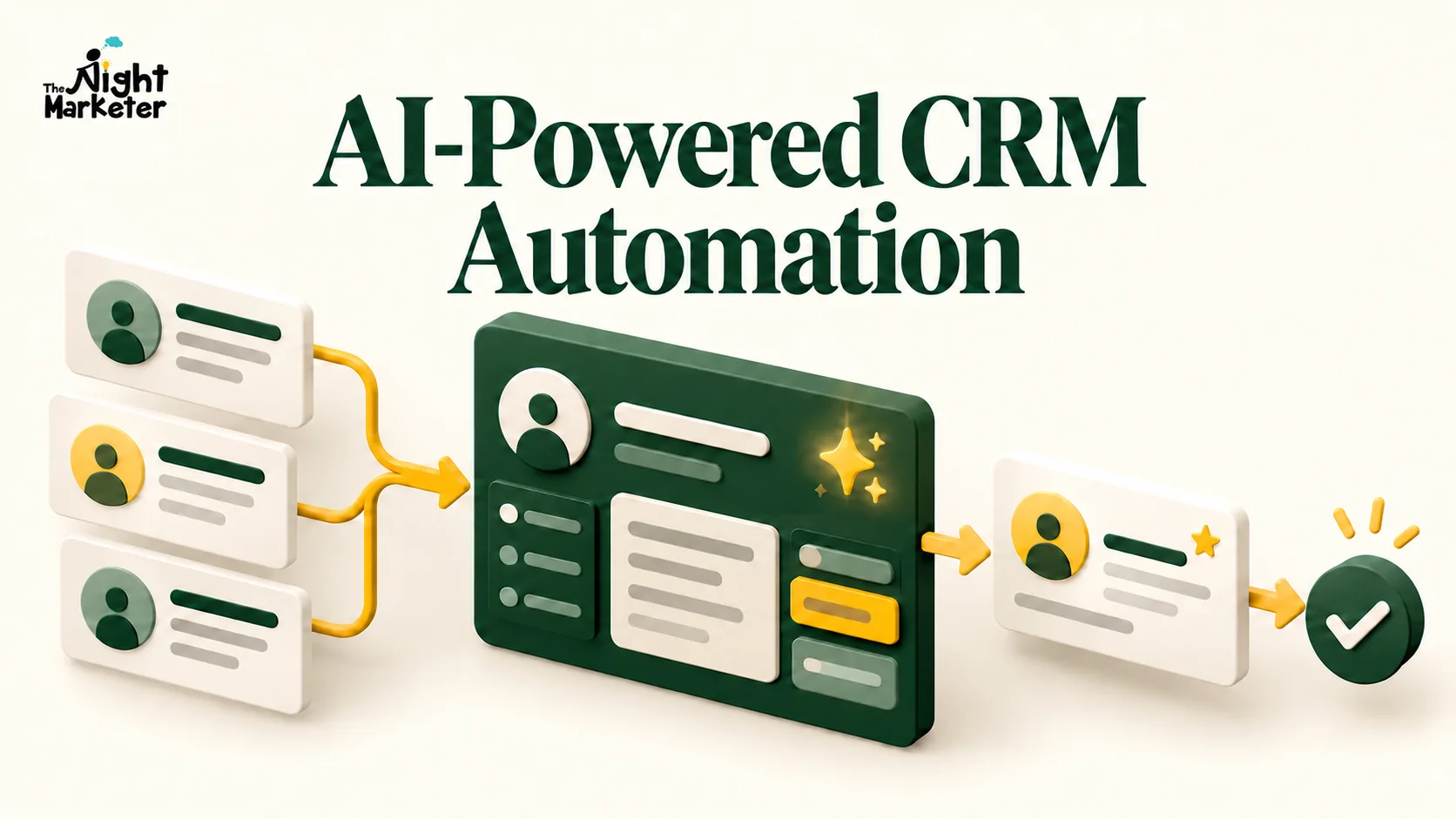
With AI-powered CRM automation, the process could work as follows:
- Lead capture: An enquiry enters the CRM automatically.
- Data processing: AI extracts relevant customer requirements, while the system checks existing records.
- Lead assignment: Defined rules assign the enquiry to an available representative.
- Follow-up preparation: AI drafts a relevant response for review.
- Sales tracking: The CRM records activity, reminders, and the next action.
A similar foundation of centralized records, lead distribution, and follow-up management can be seen in The Night Marketer's custom lead management system case study.
The case illustrates workflow automation rather than a verified implementation of every AI capability described above.
How Much Time Can AI CRM Automation Save?
The productivity benefits depend on the number of enquiries, existing processes, data quality, and the amount of human review required.
Consider this illustrative monthly calculation, based on assumed figures rather than measured results.
| Activity | Estimated time |
|---|---|
| Processing 1,000 enquiries manually at 6 minutes each | 100 hours |
| Processing enquiries with automation at 2 minutes each | 33.3 hours |
| Additional exception reviews | 6.7 hours |
| Total effort after automation | 40 hours |
| Potential time saved | 60 hours |
At an assumed labour cost of ₹600 per hour, those 60 hours represent ₹36,000 in potential capacity value.
If additional software and support costs are ₹18,000 per month, the remaining illustrative capacity value is ₹18,000 before initial setup costs.
These figures do not represent guaranteed savings or revenue growth. The actual benefit depends on whether the time saved is redirected toward productive sales activities.
Businesses should also track response times, qualified opportunities, missed follow-ups, correction effort, and CRM operating costs.
How to Implement AI-Powered CRM Automation
Successful implementation begins with identifying sales bottlenecks rather than automating every activity immediately.
1. Map your existing sales workflow. Identify how enquiries enter the CRM, who manages them, and where delays occur.
2. Select high-value automation tasks. Start with repetitive activities such as lead assignment, reminders, or record updates.
3. Prepare accurate CRM data. Review duplicates, incomplete records, ownership rules, and sales pipeline stages.
4. Test AI-generated outputs. Validate lead scores, summaries, and follow-up drafts before allowing automation to take consequential actions.
5. Monitor productivity and quality. Compare time saved, response quality, error rates, and actual sales outcomes.
Businesses with more complex workflows may benefit from AI agent development to connect systems and support specific business processes.
Challenges and Best Practices for AI CRM Automation
Although AI-powered CRM automation offers practical benefits, poorly configured workflows can create additional problems.
Common challenges include inaccurate customer records, duplicate messages, incorrect lead assignments, unreliable AI-generated information, and disconnected software systems.
To reduce these risks, businesses should establish clear ownership, maintain human review for sensitive actions, and monitor automation failures.
Customer permissions also matter. Automated messaging must respect applicable consent requirements and channel policies. For example, businesses using WhatsApp should follow the WhatsApp Business Messaging Policy.
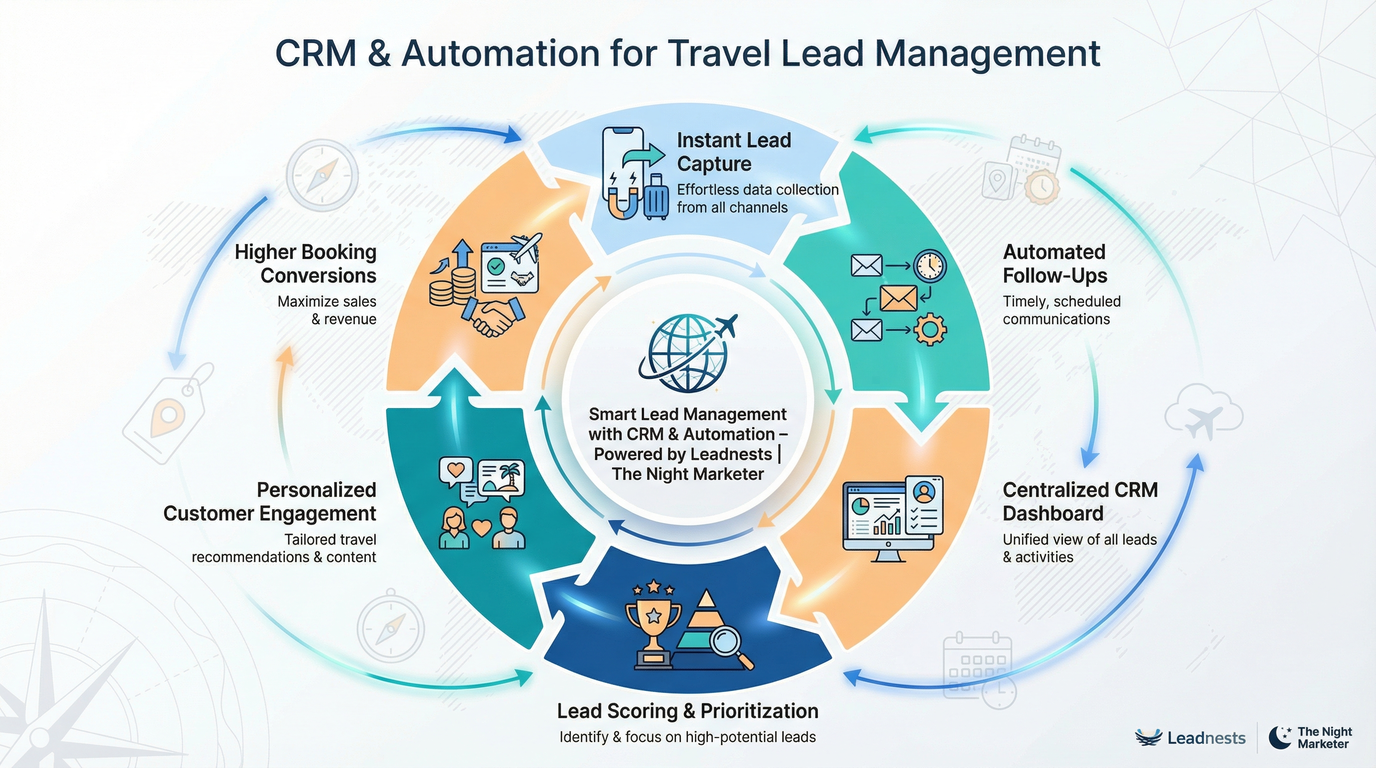
Industry-specific workflows may require additional customization. Our guide to CRM automation for travel companies explains how structured lead management supports teams handling travel enquiries.
For teams recording customer visits away from a dependable connection, see our guide to offline-first mobile apps for field teams and sales representatives.
When Does a Business Need Custom CRM Automation?
Existing CRM platforms may be sufficient when their built-in workflows match the sales process.
However, custom CRM automation may be useful when businesses need to connect multiple lead sources, manage complex assignment rules, integrate existing applications, or build specialized reporting workflows.
The decision should depend on business requirements, integration complexity, implementation costs, and long-term maintenance.
Improve Sales Productivity with The Night Marketer
AI-powered CRM automation can help businesses reduce manual work, organize customer information, and improve the consistency of sales follow-ups. The best results come from selecting the right workflows, maintaining accurate data, and measuring real business outcomes.
At The Night Marketer, we help businesses develop connected CRM solutions tailored to their sales processes, integrations, and reporting requirements.
Explore our ERP and CRM development services to discuss how your business can simplify sales operations and build more efficient workflows.