Connected operations
Reduce duplicate work by bringing important records, actions, and ownership into one system.
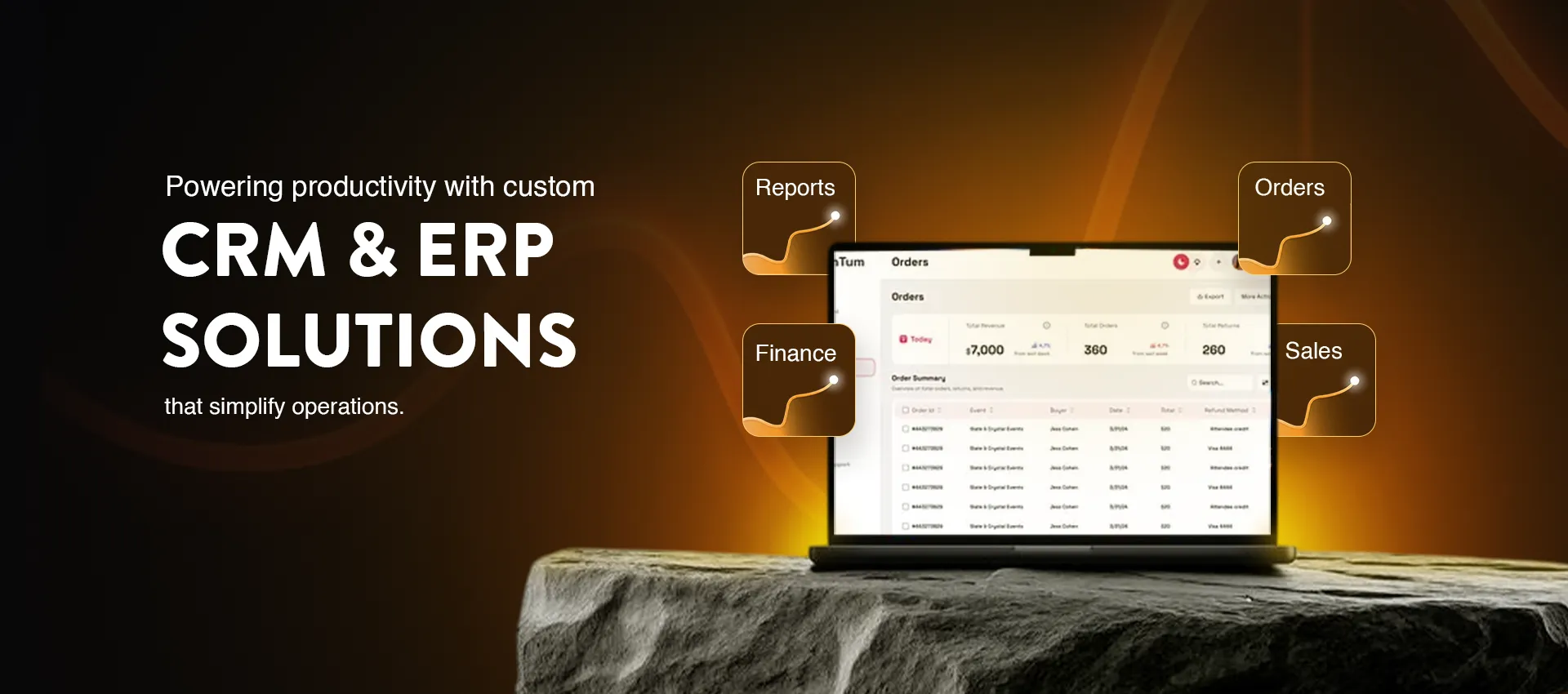
Operational software that brings customer data, sales, delivery, and reporting into one controlled workflow so teams can spend less time reconciling information and more time acting on it.
Discuss your projectOperational software that brings customer data, sales, delivery, and reporting into one controlled workflow so teams can spend less time reconciling information and more time acting on it.
Reduce duplicate work by bringing important records, actions, and ownership into one system.
Role-based dashboards and reporting that help managers understand progress and bottlenecks.
Interfaces and processes designed to be practical for the people expected to use them every day.
Every engagement is scoped to the actual priority, then delivered through the relevant strategy, creative, technical, and optimisation work.
CRM work usually starts with enquiries, sales opportunities and customer service. ERP work often covers inventory, procurement, finance and resource planning. Scope the records and handoffs that must connect, then decide whether integration of existing software is more practical than replacing it.
Agree which system owns each customer, product and transaction record. Document the roles allowed to view, change and approve information, with separate handling for confidential finance and employee records. Dashboards should show only the information needed for the user's role.
Map identifiers and required fields before importing. Test duplicates, incomplete records, failed connections and retries. Reconcile source and destination totals, retain an exception report and rehearse the recovery plan before a production cutover.
Acceptance testing should follow a record from creation through approval, fulfilment and reporting. Check permission boundaries, corrections, audit history and exports. Start with a controlled rollout and document who handles support, data issues and future workflow changes.
Align on the audience, current constraints, commercial goal, and the evidence that should shape the work.
Turn the priority into a scoped delivery plan with clear decisions, owners, and review points.
Create, build, and quality-check the work across the details that customers and teams will actually experience.
Review what changed, retain the learning, and decide the next highest-value improvement.
ERP (Enterprise Resource Planning) is a concept which merges business activities like financing, human resources and procurement. Organized around the goal of managing customer relations, CRM (Customer Relationship Management) is used to maximize sales and marketing and building loyalty.
ERP is an internal system while CRM focuses on providing solutions for external activities. ERP has an emphasis on resources, for example, inventory and payroll, whereas CRM enhances customer relations and assists the sales, marketing, and services departments.
ERP development service includes creating, deploying, and customization of ERP systems that will suit the business environment. These services improve organizational effectiveness by promoting dependencies, interconnectivity, and coordinated action that is serviced on a single system with improved decision-making capability.
CRM development services encompass designing and designing tools for capturing, processing, storing, and analyzing customer-related data. They assist the firms in enhancing customer interaction, segmenting, and enticing their clients for higher sales.
ERP enhances the flow of work by replacing manual methods and linking processes. CRM improves customer service since it is a more effective way of addressing customers and marketing. Both of them enhance efficiency, problem-solving, and customer retention which results in business development.
On-Premise ERP: Reside in the company’s servers which provides flexibility but is time-consuming to manage. Cloud ERP: Completely internet-based, virtual, and low-cost with little requirements for space and facilities. Hybrid ERP: Combines on-premise and cloud features for flexibility and scalability. Industry-Specific ERP: Specialized for certain industries and providing specific features to meet the needs of those industries.
Bring the current challenge, the growth goal, or the part of the journey that is no longer working. We will help you define a practical next step.
Talk to our teamShare the essentials and the right TNM specialist will follow up with a useful next step.