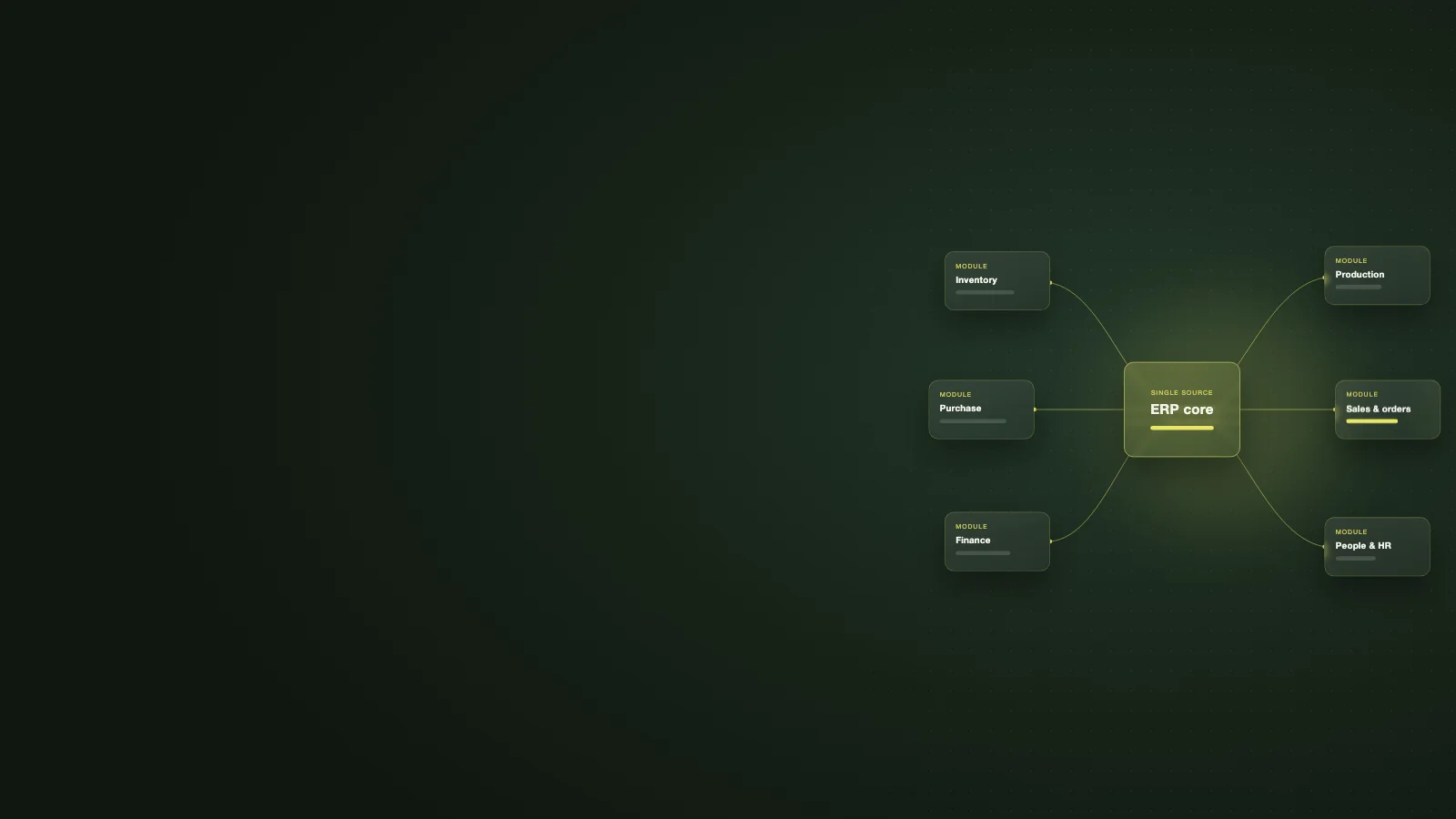
One source of truth
Stock, orders, production, purchases and invoices live in one database, so every team works from the same numbers.
ERP built around how you actually buy, make, stock, sell and account: one system for inventory, production, purchase, orders, finance and people, with the approvals and reports your team needs.
One system for inventory, production, purchase, orders, finance and people, designed around how your business actually runs and delivered in phases so operations never stop.
Stock, orders, production, purchases and invoices live in one database, so every team works from the same numbers.
Approvals, reorder alerts, dispatch and accounting handoffs run as workflows instead of daily spreadsheet updates.
Role-based dashboards for margins, stock health, order status and team performance, without waiting for month-end.
Every ERP is scoped to your process, then delivered module by module on one shared database.
Every ERP is scoped to your business, but most combine a core set of modules that share one database, so a sale, a stock movement and an invoice are the same record seen by different teams.
Ready-made ERPs suit many companies. A custom ERP makes sense when your process is your advantage, when licences and customisation keep growing, or when your team works around the software instead of with it.
The modules are similar across businesses, but the rules are not. We have built operating software for trading, distribution, logistics and commerce businesses, each with its own way of working.
These are systems our team has designed and built for real businesses and for ourselves. Each one started with how the business actually operates.
We sit with each team, document how work and data actually move, and agree the first module and how we will measure it.
Clickable screens and a data model you review with your team before any code is written.
Short development cycles, data migration with reconciliation checks, and testing on your own records.
Phased go-live, role-based training, support, and the next module once the first is proven.
A fixed-scope review of what is holding growth back, with a prioritised plan you can act on with us or on your own.
A defined scope with milestones, sign-off points and a clear launch date for new builds, redesigns and migrations.
An ongoing team for optimisation, campaigns and support, reviewed monthly against the numbers that matter to you.
It depends on the number of modules, users, integrations and how complex your process is. A focused first module can be scoped as a fixed-price phase, while a multi-module ERP is usually delivered in stages. We give a written estimate after a process mapping session rather than a guess.
A first working module typically takes weeks rather than months when the scope is focused. A full ERP covering several departments is delivered in phases over a longer period, with each phase usable on its own so your team sees value before the whole system is complete.
If a ready-made ERP fits your process with light configuration, buying is usually faster and cheaper. Custom makes sense when your workflow is unusual, licence and customisation costs keep rising, or you need deep integration with other systems. We will tell you honestly which fits.
Yes. We connect the ERP to Tally, accounting software, Shopify, marketplaces, payment gateways, couriers and other tools through their APIs or supported import formats, with checks that prevent duplicate entries. The exact method depends on each system and version.
You do. We hand over the source code, documentation and deployment details, and your data stays in infrastructure you control. You can keep working with us for support and new modules, or take the system to another team.
Bring the process that causes the most rework, delays or errors today. We will map it and show what the first ERP module should do.
Share the essentials and the right TNM specialist will follow up with a useful next step.