In short
- Understand the complete lead management funnel for travel companies
- Learn how CRM and automation improve lead conversion rates
- Discover proven strategies to capture, nurture, and convert high-quality travel leads
- Build scalable systems to increase bookings and revenue
- Implement data-driven marketing funnels for long-term business growth
Travel demand has rebounded strongly in the wake of the pandemic. With more travellers researching and booking online, the competition for each inquiry is fierce. Research from the travel industry shows that speed‑to‑lead is critical – contacting a travel lead within five minutes gives you an 80 % chance of closing the booking, but if you wait ten minutes the likelihood drops to only 5 %. And it isn’t just response time. Travellers expect relevant, personalized experiences across their journey, from the first blog post they read to the moment they confirm a trip. To maximize every opportunity, travel businesses need a structured, data‑driven lead management funnel that attracts qualified leads, nurtures them through their decision process, and converts them into loyal customers.
This guide explains how to build a high‑converting lead management funnel tailored for travel companies. It draws on industry research and real‑world examples and reflects The Night Marketer’s emphasis on design, development, marketing and automation solutions. We’ll break down the funnel stages, highlight actionable strategies and tools, and show how our LeadNests CRM & automation platform, along with our full‑suite digital marketing services, can transform your travel sales process.
Understanding the travel lead management funnel
A sales or lead management funnel maps the journey a prospect takes from discovering your travel brand to becoming a paying customer. According to travel marketing experts, a travel sales funnel has four broad stages:
- Top of funnel (Awareness) – prospects discover your business through channels like SEO, social media, paid ads and referrals.
- Middle of funnel (Interest/Consideration) – prospects learn more about your services, compare options and evaluate itineraries.
- Bottom of funnel (Decision) – highly interested travellers decide whether to book; this is the most critical stage for conversions.
- After‑purchase (Loyalty/Advocacy) – post‑booking engagement that builds loyalty and encourages referrals.
Another travel marketing guide uses similar labels – awareness, interest, consideration, and conversion – and emphasises that each stage requires different messaging and touchpoints. After conversion, nurturing through referral programs and loyalty initiatives helps you retain customers and sustain growth.
Understanding these stages is the first step in designing a funnel that guides travellers seamlessly from discovery to booking. The next step is optimising each stage with targeted strategies, automation and analytics.
Stage 1: Awareness – attracting qualified travel leads
Goal: Fill the top of the funnel with travellers who fit your niche (luxury, adventure, corporate, family, etc.) and are actively seeking travel services.
Key challenges: Visibility in a crowded market, generating traffic that converts, capturing contact details.
Strategies & tactics
- Invest in SEO and content marketing. The awareness stage is where most prospects first encounter your brand, and it’s often through search or content. Travel marketing guides recommend using SEO blog content, YouTube videos, podcasts, ebooks and paid ads to reach new audiences. Identify high‑intent keywords (e.g., “luxury safari packages,” “group tours to Bali”) and create blog posts, destination guides and comparison articles that answer travellers’ questions. The Night Marketer’s content strategists and SEO specialists can research keywords, write conversion‑focused blogs and develop optimized landing pages that attract organic traffic.
- Leverage social media and storytelling. Social platforms help you build community and inspire travellers with photos, videos and testimonials. For travel agencies, using storytelling, visually appealing imagery and targeted advertising can generate interest in your services. Our social media marketing team designs engaging campaigns and leverages influencer partnerships to showcase unique travel experiences.
- Create compelling landing pages and lead magnets. A strong landing page acts like a net that captures visitors and encourages them to leave their details. Use clear headlines, benefit‑oriented copy, trust badges and a prominent call‑to‑action (CTA) like “Plan My Trip.” Offer lead magnets such as downloadable travel planners, packing checklists or exclusive discounts to incentivize sign‑ups. The Night Marketer’s web designers and developers build high‑converting landing pages on Shopify, WordPress or custom frameworks, incorporating conversion‑rate optimization (CRO) best practices.
- Connect lead capture forms to your CRM. Don’t let valuable inquiries fall through the cracks. Real‑time lead capture ensures every enquiry feeds directly into your CRM. Bluebird notes that cloud‑based lead management systems assign leads automatically, preventing them from being lost or delayed. With LeadNests, all website forms, chatbots and ad leads feed into a single database, ready for instant assignment and follow‑up.
Real‑world benchmarks: Conversion rates vary by travel niche. Average website‑visitor‑to‑inquiry conversion rates range from 2–5 % for online booking sites to 8–15 % for adventure operators, while luxury agencies convert 10–20 %. Tracking these metrics helps you set realistic goals and see which marketing channels produce the most inquiries.
Stage 2: Interest & consideration – nurturing leads and building trust
Goal: Educate and engage prospects, qualify leads and move them toward a booking decision.
Key challenges: Responding quickly, managing multiple channels, providing relevant information without overwhelming leads.
Why speed matters
In the travel industry, response time has a direct impact on bookings. Research shows that contacting a travel lead within the first five minutes gives you an 80 % chance of closing the deal; waiting ten minutes reduces that to 5 %. Across industries, businesses that respond to leads within five minutes are 100 times more likely to connect and convert the opportunity, and you’re 21 times more likely to qualify a lead if you respond within 30 minutes. Following up in the first minute can even increase conversions by 391 %.
Strategies & tactics
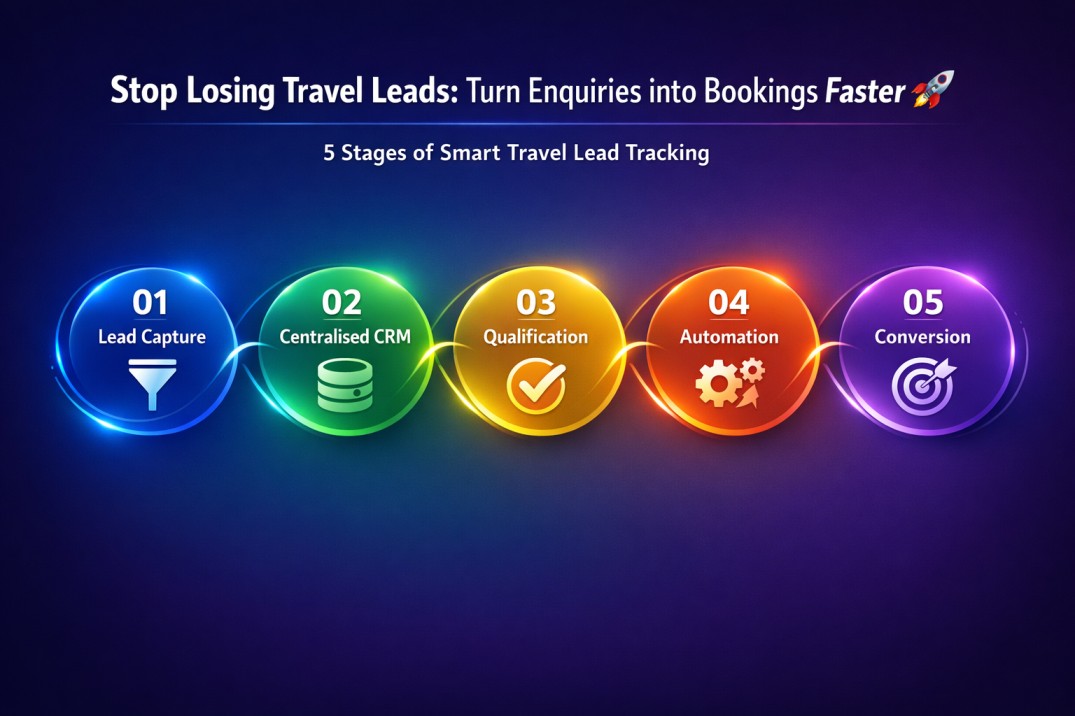
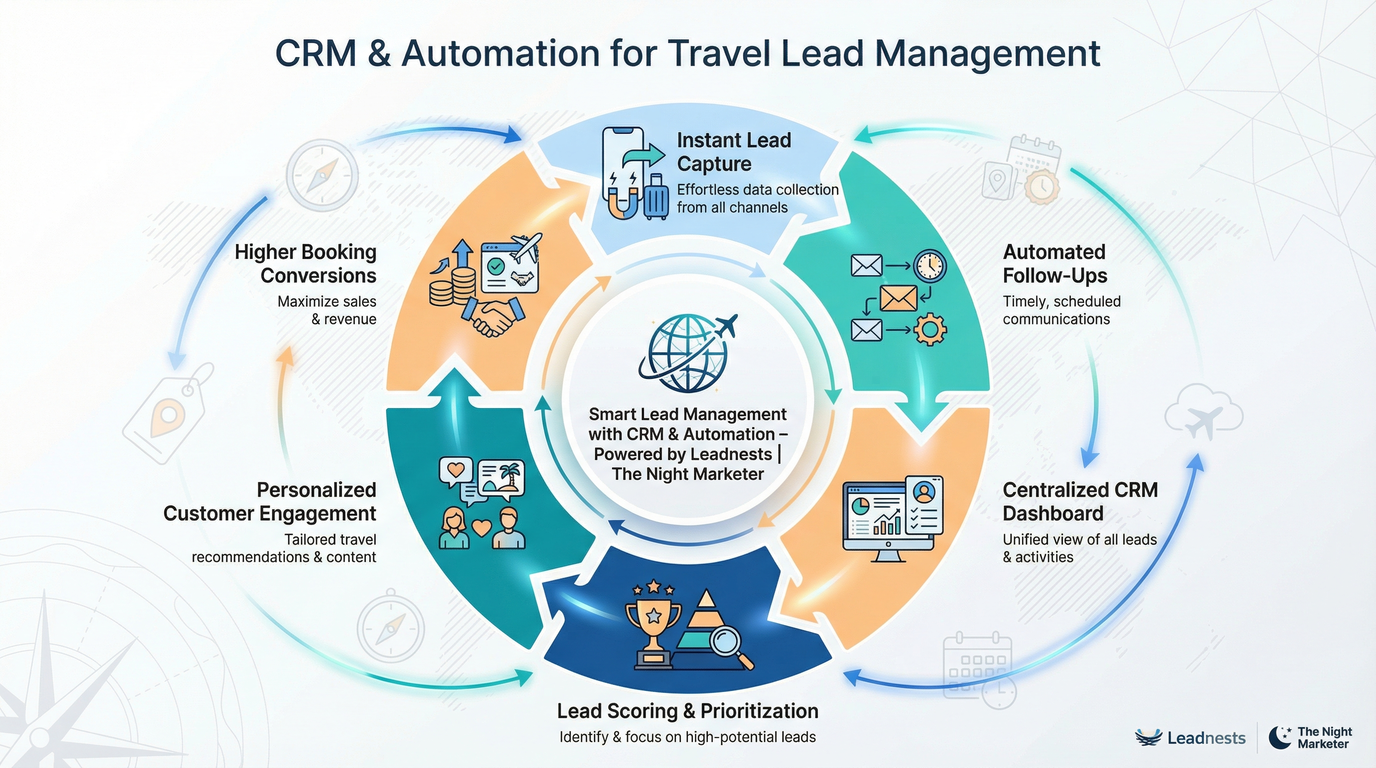
- Centralise inquiries in a travel‑specific CRM. Without a unified system, enquiries arrive via website forms, social media, email and phone, making tracking difficult. A travel‑focused CRM acts as a central hub where all lead data lives in one shared database. It provides centralised visibility, automatic task reminders and lead assignment, ensuring no prospect is missed.
- Automate follow‑up sequences. Automation transforms the CRM into a 24/7 sales assistant. A CRM can instantly send acknowledgement emails or WhatsApp messages when a lead arrives, trigger reminders when prospects don’t reply, automate repetitive tasks like sending booking confirmations and schedule follow‑ups. Lead scoring helps prioritise hot prospects.
- Instant response: Bluebird reports that real‑time lead assignment and automated messages ensure that leads are contacted immediately. Our LeadNests CRM automatically routes leads based on destination, trip type or agent workload, and can send personalised messages via email, SMS or WhatsApp within seconds.
- Multi‑channel nurturing: Use email drip campaigns, personalised video messages, webinars and WhatsApp sequences to educate leads about destinations, itineraries and travel tips. Tools like chatbots can engage website visitors instantly – 67 % of consumers prefer chatbots, and businesses see 35–40 % response rates from chatbot conversations.
- Personalise the experience. Travel is highly personal. A good CRM stores preferences, past trips, budgets and visa needs so agents can tailor proposals. Segment leads by traveller type (honeymooners, families, business travellers) and send them targeted content. Use dynamic pricing and itinerary builders to create customised proposals. Our AI‑driven agents can pre‑qualify leads, schedule appointments and recommend packages based on user behaviour.
- Educate with value‑driven content. Create blog posts, destination guides, webinars and videos that answer common questions. Travel agencies can nurture leads by providing valuable content and personalised experiences. Our content team can craft helpful guides, while our designers can create interactive itineraries and trip planners to keep leads engaged.
Real‑world examples:
- Luxury travel agency: A luxury agency generating 150 monthly inquiries converted 14 % of them into high‑value bookings, illustrating that a well‑nurtured, high‑intent audience can produce strong conversion rates.
- Adventure tour operator: An adventure operator attracted 800 monthly website visitors; 120 submitted inquiry forms and 18 booked treks – a 15 % inquiry‑to‑booking conversion and 2.25 % overall website‑to‑booking conversion. The operator used detailed itineraries and video calls to convince prospects.
- Corporate travel management: A corporate travel provider turned 340 out of 400 quarterly requests into confirmed trips (85 % conversion), thanks to structured processes and streamlined booking.
These examples show that conversion rates vary widely by travel niche and the quality of lead nurturing. Automating your follow‑ups and personalising your communications dramatically improves conversion chances.
Stage 3: Decision – converting prospects into bookings
Goal: Remove friction from the booking process and compel ready‑to‑book travellers to commit.
Key challenges: Complex itineraries, price sensitivity, trust signals, and negotiation.
Strategies & tactics
- Optimise your booking experience. The conversion stage is where all your marketing efforts pay off. Ensure your website or booking engine is intuitive, mobile‑friendly and secure. Provide clear pricing, inclusions, availability calendars and multiple payment options. Offer live chat or click‑to‑call features so travellers can quickly ask questions or confirm details. The Night Marketer builds custom booking portals, Shopify/WordPress websites and mobile apps with seamless UX/UI that make booking easy.
- Use persuasive triggers and trust‑building elements. Highlight limited‑time offers, early‑bird discounts or value‑added perks like free room upgrades or airport transfers. Display customer reviews, case studies and testimonials to build confidence. Share stories of happy clients who saved time and money with your agency’s expertise. Our branding and graphic design team can create visually appealing testimonials and badges.
- Implement dynamic pricing and upselling. Travel itineraries often have multiple components. Use CRM data to recommend add‑ons (e.g., excursions, travel insurance) based on the traveller’s interests. Offer package upgrades or flexible payment plans. For high‑touch sales, schedule a call or video consultation to answer questions and close the booking. Our LeadNests CRM supports quote management and can automate deposit invoices and payment reminders.
- Track conversion metrics. Use your CRM and analytics tools to monitor conversion rates at each stage – website‑visitor‑to‑inquiry, inquiry‑to‑quote, quote‑to‑booking. Compare performance by channel (email, social media, referrals), by season and by trip type. This data reveals bottlenecks and guides optimization efforts.
Benchmarks: Conversion benchmarks in the travel industry range from 2–5 % for online booking sites, 8–15 % for adventure operators, 10–20 % for luxury agencies and 70–90 % for corporate travel management. Knowing your niche’s typical rates helps you set realistic targets and focus on continuous improvement.
Stage 4: Loyalty & advocacy – retaining customers and generating referrals
Goal: Turn one‑time bookings into repeat business and enthusiastic referrals.
Key challenges: Maintaining engagement after the trip, encouraging reviews and referrals, delivering personalised loyalty rewards.
Strategies & tactics
- Deliver outstanding post‑trip service. Send thank‑you emails, request feedback and provide travel photos or trip summaries. Use CRM data to note important milestones (e.g., anniversary trips, annual vacations) and send relevant offers. Promptly address any issues during or after the trip. Personalised after‑sales engagement builds trust and increases repeat bookings.
- Implement referral and loyalty programs. Travel agencies can tap into clients’ networks by offering discounts, rewards or exclusive benefits to both referrers and the referred. Loyalty initiatives – such as points systems, personalised offers or VIP events – encourage repeat bookings and deepen long‑term relationships. Our marketing team can design referral campaigns, build loyalty portals and automate reward distribution.
- Gather and showcase reviews and testimonials. Encourage satisfied customers to leave reviews on Google, TripAdvisor and your website. Positive social proof boosts credibility and conversion rates. Display reviews prominently on your site and share them across social channels.
- Upsell complementary services. Suggest future trips, upgrades or related experiences based on past behaviour and preferences. Use email nurturing to share exclusive deals or early‑bird offers tailored to your customers’ interests. Our email marketing services can automate segmented campaigns to cross‑sell tours or destinations.
Long‑term impact: By leveraging referral programs and loyalty initiatives, travel agencies can retain existing clients and acquire new ones through word‑of‑mouth. Repeat customers are cheaper to acquire and often have higher lifetime value, making loyalty a critical driver of sustainable growth.
Building your high‑converting travel lead funnel: step‑by‑step
Creating a high‑performing lead management funnel requires aligning people, processes and technology. Here’s a blueprint you can follow:
- Map your buyer personas and travel niches. Understand who your ideal travellers are (e.g., luxury honeymooners, budget backpackers, corporate groups) and what motivates them. Tailor your funnel, content and offers accordingly.
- Audit your current funnel and set goals. Measure conversion rates at each stage and identify gaps. Establish KPIs such as website‑visitor‑to‑inquiry rate, lead response time, inquiry‑to‑booking conversion rate and repeat booking rate. Compare them with industry benchmarks.
- Choose the right CRM and integrate your channels. A travel‑specific CRM like LeadNests by The Night Marketer centralises inquiries, customer profiles and tasks. Connect your website forms, chatbots, social ads and booking engine so that all leads flow into the CRM automatically.
- Build automation workflows. Design automated sequences for immediate acknowledgement, follow‑up reminders, task assignments, lead scoring and drip campaigns. Use conditional logic (e.g., different messaging for honeymooners vs. adventure seekers) to personalise communication. Our automation specialists can implement marketing automations across email, SMS, WhatsApp and chatbots.
- Create compelling content and landing pages. Use storytelling, detailed itineraries, videos and interactive tools to engage leads at each stage. Optimise your pages for search and conversion. The Night Marketer’s creative team handles branding, graphic design, copywriting and development, ensuring your digital assets reflect your travel expertise.
- Implement real‑time routing and scheduling tools. Ensure leads are assigned to the right agent instantly and can schedule calls or consultations with one click. Our LeadNests platform integrates calendar scheduling and AI‑powered chat to connect travellers with travel experts immediately.
- Train your team and build a sales cadence. Educate staff on using the CRM, following up promptly, and maintaining a consistent cadence across channels. Determine the number of touches, channel preferences and spacing between contacts. Use dashboards to monitor adherence and improve performance.
- Track, analyse and refine. Review funnel analytics weekly: measure response times, channel performance, conversion rates and customer satisfaction. Adjust your content, ads and automation workflows based on data. Set seasonal and niche‑specific benchmarks. Continuous testing and optimisation are key to increasing conversion rates.
Why choose us for your travel lead funnel
At The Night Marketer, we believe that great travel marketing blends creativity, technology and data. Our brand mission is to deliver “Design, Development, Marketing & Automation solutions for a strong digital foundation” – a philosophy we apply to every client project. Here’s how we support travel businesses:
- Full‑suite digital marketing. From SEO and Google Ads to social media campaigns and email marketing, we attract high‑quality leads and build your brand presence. Our content writers and designers craft visually stunning blogs, guides and videos that inspire travellers.
- Custom web and mobile development. Whether you need a tailored booking website, a Shopify store for travel packages or a mobile app for itinerary management, our developers create secure, scalable solutions that evolve with your business.
- LeadNests CRM & automation. Our travel‑specific CRM centralises every lead, automates follow‑ups, scores prospects and provides real‑time analytics. It integrates seamlessly with your website, ads and booking systems, ensuring no inquiry gets lost.
- AI and cloud automation. We implement AI agents to pre‑qualify leads, automate repetitive tasks and personalise communications. Cloud infrastructure ensures your systems run smoothly and scale effortlessly.
- Conversion rate optimisation & analytics. We continuously test and refine your landing pages, emails and funnels, using data to maximise conversions and ROI. Our dashboards provide transparent visibility into every stage of your funnel.
- End‑to‑end funnel consulting. We map your customer journey, design content strategies, implement automation workflows and train your team. Our consultants become an extension of your travel company, guiding you through every phase of growth.
Conclusion – turn enquiries into bookings with us
In today’s fast‑moving travel industry, relying on spreadsheets and manual follow‑ups is no longer enough. Travellers expect instant responses, personalised itineraries and seamless booking experiences. Research shows that fast response times (within five minutes) can increase your chances of closing a travel sale from 5 % to 80 % and that businesses responding within five minutes are 100 times more likely to connect and convert leads.
Building a high‑converting lead management funnel requires a holistic approach: attracting qualified traffic, nurturing leads with relevant content, automating follow‑ups, delivering frictionless booking experiences, and cultivating long‑term loyalty. By leveraging a travel‑specific CRM, automation workflows, targeted marketing and data‑driven optimisation, travel companies can dramatically increase conversion rates across all stages of the funnel.
If you’re ready to transform inquiries into happy travellers, The Night Marketer is here to help. Our LeadNests CRM, automation tools, and full suite of design, development and marketing services provide everything you need to build a funnel that turns interest into bookings and bookings into long‑term relationships. Contact us today to start building your high‑converting travel lead management funnel.