In short
- Fast response times are critical in travel sales — contacting leads within minutes significantly increases booking conversions.
- Manual lead handling leads to lost opportunities — scattered emails, spreadsheets, and delayed follow-ups cause revenue leakage.
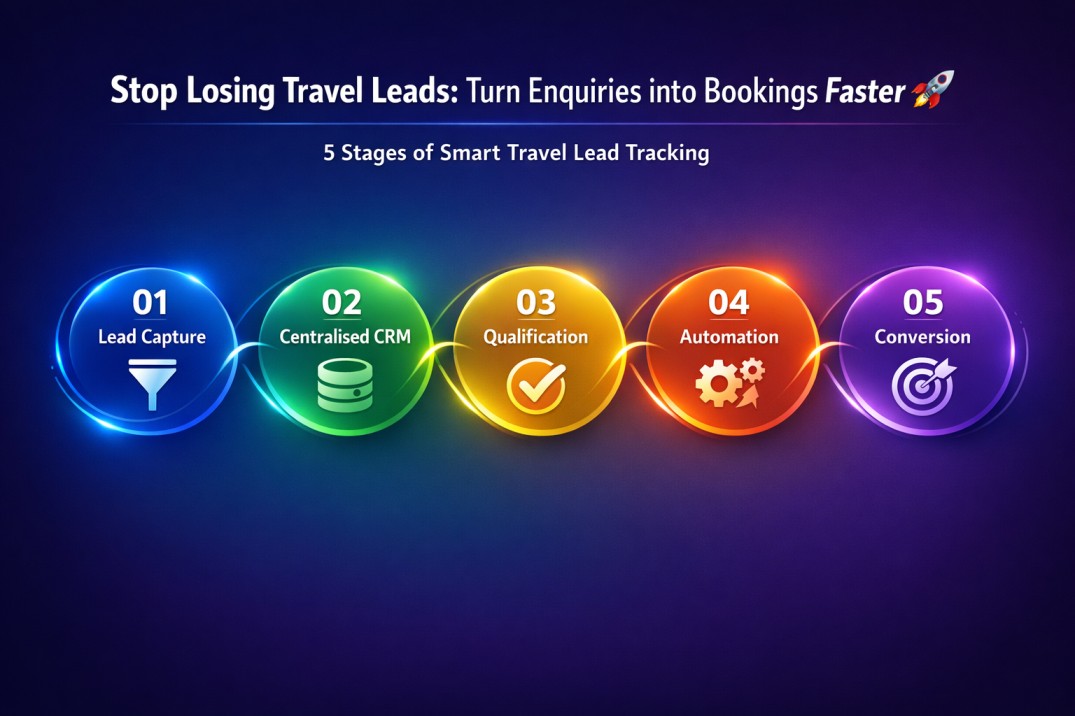
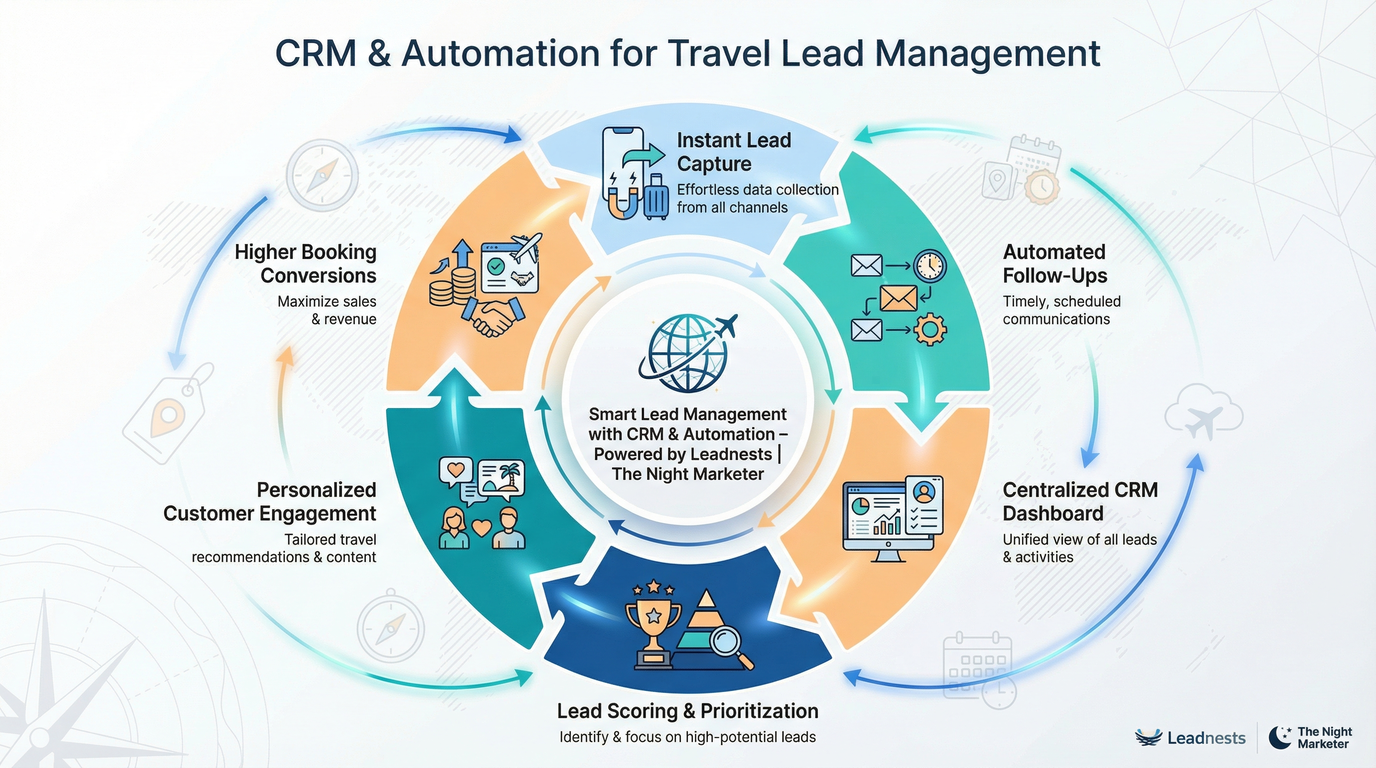
- CRM centralises all travel leads and customer data, ensuring complete visibility, better tracking, and zero missed follow-ups.
- Automation improves speed, consistency, and engagement, enabling instant responses and timely follow-ups without manual effort.
- Lead scoring and prioritisation help agents focus on high-intent customers, increasing efficiency and sales success.
The travel industry is uniquely fast-paced and seasonal, meaning leads arrive unpredictably and must be acted on immediately. In fact, one study shows that contacting a travel lead within 5 minutes of inquiry gives an 80% chance of closing a sale, whereas waiting just 10 minutes drops that likelihood to 5%. Yet many travel agencies still juggle leads through scattered emails, calls, and spreadsheets. This chaotic approach often lets promising enquiries “fall through the cracks” – a silent revenue killer. As Nutshell reports, running a travel business on “institutional knowledge and luck” (i.e., no CRM) only invites disaster, whereas the right CRM “transforms this chaos into organised, predictable revenue”.
The Lead Management Challenge in Travel
Travel agencies and tour operators face several lead-management hurdles:
- Fragmented Lead Sources: Enquiries pour in via website forms, social media, email, phone calls, and adverts. Without a unified system, tracking each prospect is error‑prone.
- Slow Response Times: Speed to lead is critical. Bluebird notes that real‑time lead assignment (often via cloud CRM) ensures no inquiry is left unassigned, reducing the risk of lost sales. Even a few minutes’ delay can cost the booking.
- Manual Follow-Ups: Without automation, staff must remember to email or call each prospect. It’s easy to miss or forget a follow‑up. Jetpack CRM observes that agencies relying on spreadsheets or memory often drop leads: “When your inboxes fill up, so did your list of missed prospects ”.
- Lack of Visibility: Managers cannot see the pipeline or know which agent is working on which lead. This leads to duplicate efforts (two agents contacting the same customer by accident) or, worse, no one contacting them at all.
Each of these challenges contributes to lead loss. Nutshell stresses this point: “Lead loss between team members is the silent revenue killer for travel agencies.” Without a system in place, a prospect can easily slip away – for example, a Friday lead goes unassigned and, by Monday, has booked elsewhere.
How CRM Centralizes Leads and Data
A travel‑focused CRM solves these problems by acting as a central hub for all customer information. Think of it as your agency’s digital memory: every inquiry, email, call log, and booking note lives in one shared database. Key benefits include the following:
- Centralised visibility: Every team member “sees every lead in one place”. No more hunting through personal inboxes. When an agent opens the CRM, they instantly see who the prospect is, when they enquired, and what’s needed next.
- Automatic task reminders: CRMs can auto‑schedule follow‑ups. If a customer needs a call in 2 days, the system creates the task and notifies the assigned agent. This prevents enquiries from languishing.
- Lead assignment and tracking: The CRM routes leads to the right person (based on territory, speciality, or workload) and logs who is responsible. You’ll always know exactly which agent is handling a given inquiry.
- Rich customer profiles: Travel CRMs let you store preferences, past trips, visa needs, budget, and more. When a repeat customer calls, the agent has their entire history at a glance, enabling very personalised service.
Together, these features mean no lead is “lost in the shuffle". As one travel‑CRM provider put it, without CRM you’re left “relying on individual memory and hope". With CRM, leads become organised opportunities.
The Power of Automation: Speed and Consistency
Automation is what makes a CRM truly transformational for travel lead management. By programming follow‑up actions into the system, agencies ensure instant, consistent outreach to every prospect. For example:
- Instant follow-ups: As soon as a lead comes in, automated messages (via email, SMS or even WhatsApp) can go out acknowledging the inquiry and providing initial info. Bluebird’s lead management guide emphasises that cloud‑based systems “automatically capture leads from Meta, Google Ads, chatbots & landing pages” so no inquiry waits unanswered.
- Automated reminders: If a customer doesn’t respond to the first message, the CRM can trigger a reminder or task. Travel operators frequently cite missed reminders as the reason for lost sales. With automation, every “next action” is scheduled for you.
- Task automation: Repetitive tasks like sending booking confirmations, deposit invoices, and pre‑trip instructions can be automated in the CRM workflow. This frees agents to handle complex itinerary planning and sell more trips.
- Lead scoring and prioritisation: Many CRMs offer lead scoring (ranking leads by engagement or profile) so agents focus on high‑potential clients first. Combined with automation, this means the hottest enquiries get immediate attention.
These automations have a dramatic effect. Nutshell reports that “with proper CRM follow-up automation, travel agencies see +25–40% conversion improvement”. In other words, automated follow-ups turn tentative “maybes” into firm bookings. Vtiger similarly notes that CRMs “dramatically improve conversion rates” by ensuring every prospect is engaged promptly.
Key Benefits: Higher Conversions, Productivity and Satisfaction
Implementing CRM and automation yields multiple wins for travel firms:
- Faster conversions: Quick, systematic follow-up means leads convert into bookings at far higher rates. In one example, a travel agency using CRM saw a 25% jump in lead conversion and a 30% rise in repeat bookings.
- Improved efficiency: Automated lead assignment and task reminders free agents from manual busywork. Jetpack CRM’s case study showed that once leads and tasks were organised in the CRM, agents stopped “wrestling with spreadsheets” and instead focused on selling. Productivity soars when every team member knows exactly which leads need attention each morning.
- Better customer experience: Travel is highly personal. With CRM, agents access full customer histories and preferences, enabling personalised travel packages and timely updates. This tailored service boosts satisfaction and loyalty. As phptravels writes, agents can track preferences to offer “tailored travel packages and recommendations", turning first-time travellers into repeat clients.
- Data‑driven decisions: Consolidated data lets managers see which tours are selling, which agents perform best, and which marketing channels deliver leads. Built-in analytics mean agencies can optimise offerings and marketing spend in real time (e.g., abandoning underperforming ads).
Overall, the ROI on CRM+automation is clear: fewer “maybe” leads slipping away, more bookings, and happier clients. One travel CRM provider summarises: a CRM “helps travel companies improve their lead management and conversion process, increase sales efficiency, [and] streamline follow-ups” – in short, it multiplies bookings and revenue.
Getting Started: Implementing CRM & Automation
For a travel agency considering CRM + automation, success starts with setting goals and choosing the right tools:
- Define your needs: Identify your biggest pain points (e.g., lost web leads, slow follow-ups, and disjointed data). Your CRM must address these.
- Select travel‑specific CRM: Look for solutions with features like integrated itinerary builders, GDS/API connectivity, and mobile apps. Many CRMs now offer automation templates for travel (e.g., post‑inquiry emails and date‑based reminders).
- Integrate channels: Connect your website, social media, and booking engine to the CRM so all leads flow in automatically (some systems even auto-capture leads from Google/Facebook ads).
- Set up automation workflows: Program the CRM to send acknowledgements, reminders, and follow-ups automatically. Include segmentation (e.g., different emails for honeymooners vs. business travellers). Use lead scoring so hot prospects are flagged.
- Train your team: Ensure agents know how to use the CRM dashboards and alerts. Involve them in customising fields (e.g., preferred destinations, package types) so data entry is meaningful.
- Monitor and iterate: Review CRM analytics weekly. Track response times, conversion rates, and pipeline progress. Refine your automated messages and reminders based on what works.
By following these steps, travel agencies can transform their lead funnel. Bluebird emphasises that travel managers should ask questions like “How long does it take to respond to a lead?” and use the CRM’s real-time dashboards to continuously improve.
Conclusion
In today’s competitive travel market, using a CRM with automation is no longer optional – it’s essential. Yet, many travel agencies still struggle with scattered leads, delayed follow-ups, and lost booking opportunities. If your team is facing challenges in managing enquiries, tracking follow-ups, or converting leads into confirmed bookings, Leadnests by The Night Marketer is built specifically to solve these problems.
Leadnests ensures that every enquiry is instantly captured, organised, and nurtured through smart automation. From real-time lead distribution and instant follow-ups to centralised customer data and intelligent reminders, our platform empowers your team to respond faster, engage better, and convert more. This is especially critical for time-sensitive and last-minute travellers, where even a few minutes’ delay can mean a lost booking.
By automating repetitive tasks and streamlining lead workflows, LeadNests allows your agents to focus on what truly matters — creating memorable travel experiences and closing more bookings. Travel companies using Leadnest experience higher conversion rates, smoother operations, and improved customer satisfaction.
The future of travel sales belongs to agencies that work smarter, not harder — and that journey starts with LeadNests, your complete CRM & automation solution for smarter lead management.