In short
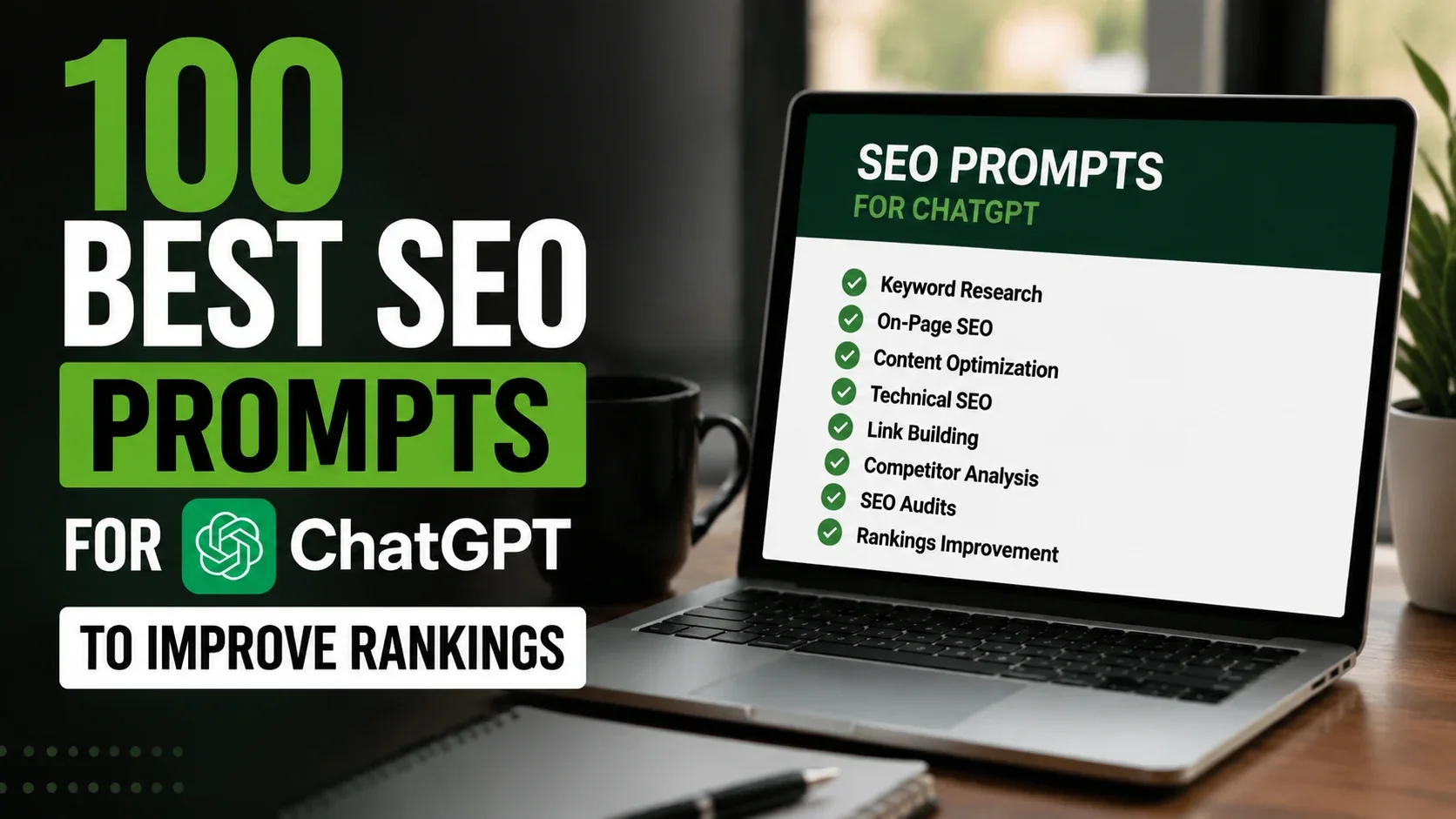
- AI tools powered by large language models can automate many SEO tasks such as keyword research, audits, and content optimization.
- ChatGPT prompts help marketers generate insights, analyze competitors, and improve website performance faster.
- Technical SEO prompts can identify crawl errors, broken links, redirect chains, and page speed issues.
- AI keyword research can uncover long-tail keywords and group them by search intent for better targeting.
- On-page SEO prompts help create optimized titles, meta descriptions, headings, and internal linking strategies.
- Content SEO prompts can generate outlines, identify content gaps, and improve engagement.
- Competitor analysis prompts help discover ranking opportunities and keyword gaps.
- AI analytics prompts can summarize Google Analytics data and identify traffic trends or anomalies.
- Backlink and off-page SEO prompts help identify link opportunities and craft outreach strategies.
- Combining AI insights with human expertise leads to stronger SEO strategies and better long-term results.
Artificial intelligence is transforming every stage of search engine optimisation. Tools built on large language models can now ingest a website’s structure, content, and analytics, surfacing insights in minutes that would take humans hours or days. Semrush defines AI SEO as the use of machine learning and large language models to automate and enhance SEO tasks, helping small teams compete with larger competitors by freeing them from repetitive research and analysis. Modern AI models use natural language processing to understand search intents and analyse competitor content. AI‑driven auditing tools flag crawl errors, broken links, and page‑speed issues, while AI‑powered analytics highlight traffic anomalies and forecast performance.
The real magic comes in how you instruct these tools. A prompt is a concise request that tells ChatGPT, an AI language model, what you need, whether that’s a keyword list, a competitor gap analysis, or a draft Google Business Profile description. This guide explains why each SEO discipline matters, shows how AI can streamline it, and offers ready-made prompts that you can adapt to analyse, optimise, and rank your website faster.
To appreciate the power of AI SEO, consider the broad categories of tasks it can handle. Large language models don’t just spit out keywords; they digest your entire website and its competitive landscape to surface actionable insights. The Semrush team divides AI SEO into four key capabilities: automation, data analysis, content optimisation, and predictive insights. When combined, these capabilities allow small teams to compete with big brands because they eliminate repetitive work and provide a level of insight normally reserved for advanced analysts.
Key benefits of AI‑powered SEO include:
- Automation of repetitive tasks: AI tools automate keyword research, link audits, and meta tag generation, saving countless hours.
- Data insights & predictive analysis: Machine learning, a subset of AI that enables systems to learn from data, uncovers search trends and forecasts traffic anomalies before competitors act.
- Content optimisation: natural-language processing ensures titles, headings, and copy align with search intent and readability standards.
- Scalability and efficiency: Automating routine tasks provides consistent, cost‑effective results that scale SEO efforts for teams of any size.
ChatGPT Prompts for Website SEO Audit
A technical audit checks whether search engines can crawl, index, and understand your pages. AI‑powered crawlers like Screaming Frog, DeepCrawl, and Botify can scan entire sites, detecting 404 errors, broken links, and redirect loops. They also identify duplicate pages, canonicalization problems, and pagespeed bottlenecks. Use ChatGPT to synthesise audit results and prioritise fixes.
Common problems include:
- Fix broken links, redirect chains, and duplicate content to maintain crawl efficiency and avoid diluted ranking signals.
- Remove crawl barriers such as orphan pages and blocked robots.txt paths, and improve page speed with image compression, code minification, and caching.
- Implement HTTPS, canonical tags, and schema markup to enhance security and provide structured data.
Prompts
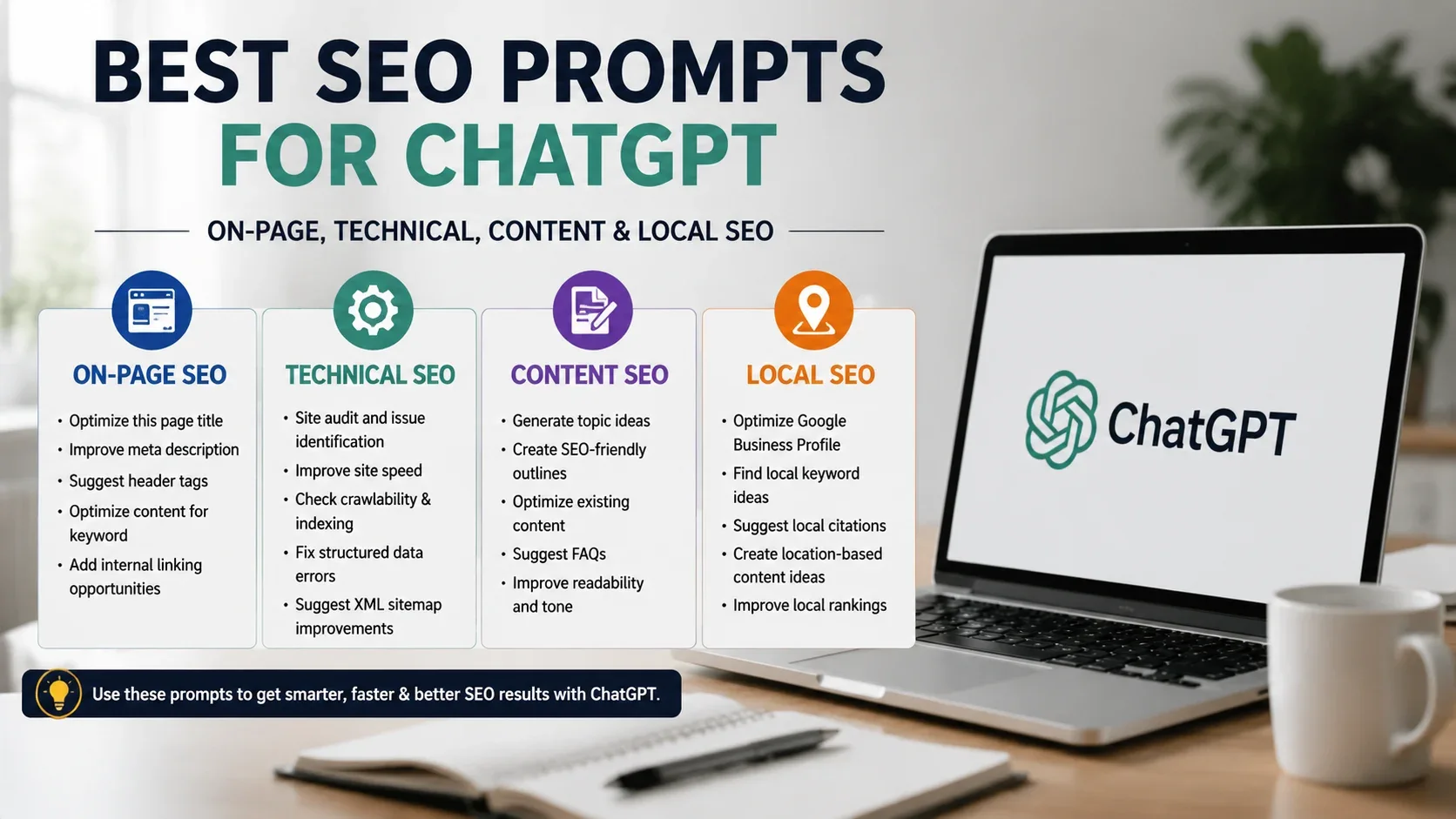
"Act as a technical SEO auditor. I will provide my domain and a summary of crawl data. Identify the most critical issues (broken links, duplicate content, redirect loops, and thin pages) and recommend the top five fixes."You are an SEO specialist. Review this sitemap and list of indexable pages. Identify any orphan URLs or pages blocked by robots.txt, and explain how these issues affect crawlability."
Keyword Research Prompts
Keyword research reveals how your audience searches and which phrases will drive high‑quality traffic. AI excels at surfacing patterns across millions of queries. In a Semrush survey, 60% of marketers said they use ChatGPT for keyword research, and 48% use AI to brainstorm content ideas. AI models can cluster keywords by intent and suggest conversational long‑tail terms.
Use AI to:
- Group keywords by intent (informational, navigational, commercial, and transactional) to align content with searcher goals.
- Discover long‑tail and conversational phrases, including voice and local “near me” queries.
- Build topic clusters and find low‑competition opportunities to improve topical authority, such as identifying relevant subtopics and creating content that addresses specific user queries and interests.
Prompts
"Act as an SEO strategist. For the topic '[industry or product]', generate a list of 12 high-intent keywords, categorising them as informational, commercial, or transactional."Create a topic cluster around '[seed keyword]'. Identify one pillar theme and at least four supporting article titles. For each, specify the intended stage of the buyer journey."
Technical SEO Prompts
Technical SEO makes your site easy for search engines to crawl and index. AI-driven audits rapidly identify technical issues, such as crawl errors, broken links, duplicate content, and redirect chains. They also analyse page speed metrics and predict which optimisations will have the greatest impact on the user experience. Use ChatGPT to turn raw crawl data into prioritised tasks.
Technical checklists should:
- Audit redirection chains, broken links, and server errors to streamline crawling.
- Optimise page speed with compression, minification, and caching, and monitor Core Web Vitals.
- Ensure HTTPS, canonical tags, and structured data are implemented correctly to prevent duplicate content and aid indexing.
Prompts
"You are a technical SEO engineer. Based on this list of URLs and response codes (pasted below), identify any chains of 3xx redirects and recommend consolidations to improve crawl efficiency."Review the following PageSpeed Insights report summaries: List three optimisations (image compression, code minification, caching, etc.) that will most improve Core Web Vitals, and explain why."
On‑Page SEO Optimisation Prompts
On‑page SEO ensures each page is relevant and compelling for users and search engines. AI content optimisation tools use machine learning models to understand search intent, suggest better titles and meta descriptions, and recommend internal links. They can generate optimised metadata in seconds and propose structural improvements that enhance readability.
On‑page prompts should:
- Craft compelling titles and meta descriptions that include primary keywords and clear benefits.
- Structure content with hierarchical headings (H1, H2, H3) and relevant internal links.
- Improve readability, optimise image alttext, and use bullet lists to enhance the user experience.
Prompts
"Act as an on‑page SEO expert. Given this article summary, generate three alternative SEO‑friendly titles and meta descriptions incorporating the primary keyword and a clear value proposition."Review the following draft article outline. Suggest logical H2 and H3 headings, and identify where internal links to existing relevant pages on my site could improve topical depth."
Content SEO Prompts
Quality content drives rankings and engagement. AI tools trained on large datasets can analyse top-performing pages to identify secondary keywords, detect content gaps, and suggest structural improvements. They accelerate production and provide real‑time insights into what is ranking, while helping writers brainstorm introductions and overcome creative blocks.
Content prompts can:
- Create detailed outlines that cover audience questions and incorporate semantic keywords.
- Identify content gaps compared to top-ranking pages and highlight overlooked subtopics.
- Write engaging introductions and conclusions, and adhere to E‑E‑A‑T guidelines for trustworthiness.
Prompts
"Act as a content strategist. For the keyword '[keyword]' and audience '[audience]', create a blog outline with an engaging introduction, three main sections (with working titles), and a conclusion. Include bullet points of questions to answer in each section."Provide a list of secondary keywords and semantically related terms for '[keyword].' Group them by search intent and suggest how to weave them naturally into content."
Competitor SEO Analysis Prompts
Competitor analysis helps you spot opportunities. The Competitive Intelligence Alliance notes that AI‑powered tools automate tedious ranking and backlink research and turn data into strategic insight. They monitor SERP changes, perform deep semantic content gap analyses, and generate content briefs identifying subtopics that top‑ranking pages miss.
Use AI to:
- Benchmark competitors' keywords and analyse their content structures to understand their strategy.
- Discover gaps and subtopics that the top pages overlook to inform your own content.
- Track competitor backlinks and SERP volatility to uncover link opportunities and react to algorithm updates.
Prompts
"Act as a competitor analyst. Given the domain '[competitor domain]', list their top 10 organic keywords with search volume and intent. Highlight any high-opportunity terms that my site [your domain] doesn’t currently target. "Perform a content gap analysis. Compare this draft outline to the top three ranking pages for '[keyword]' and list at least three subtopics or questions those pages overlook that I could address."
Website Performance & Analytics Prompts
SEO success requires understanding how visitors interact with your site. AI‑driven analytics platforms automate data analysis, detect anomalies, and provide predictive insights. DigGrowth explains that AI-powered Google Analytics reports automate complex analyses, flag anomalies, and deliver real-time insights so businesses can act before competitors do. They can summarise key trends, forecast traffic and conversion rates, and identify sudden shifts in user behaviour.
For actionable analytics:
- Visualise traffic sources and anomalies to inform marketing budgets.
- Segment users by device or location and forecast future traffic based on historical trends.
- Provide role‑based insights tailored to executives, marketers, and developers so each team member sees relevant metrics that help them make informed decisions about their specific areas of responsibility and strategy.
Prompts
"Act as a data analyst. Using this GA4 export (pasted table), summarise the top three traffic sources and any unusual spikes or drops in sessions over the past month. Suggest possible causes. "I exported a funnel report showing product views, add-to-cart events and purchases. Identify where most users drop off and propose two hypotheses to improve conversions."
Backlink & Off‑Page SEO Prompts
Off‑page SEO—including link building—signals trust and authority to search engines. AI can streamline prospect research, personalise outreach, and suggest guest posting topics. Singularity Digital notes that AI tools quickly pinpoint high-quality sites aligned with your niche and help craft personalised outreach emails and guest post drafts. They also summarise competitors' pages to identify relevant link targets.
AI can assist with:
- Identify authoritative sites and broken link opportunities for high‑quality backlinks.
- Analyse competitor backlinks and craft personalised outreach emails referencing mutual interests.
- Diversify anchor text and avoid over-optimisation to build a natural backlink profile.
Prompts
"Act as a link‑building strategist. Based on these seed sites and my niche [description], identify eight high‑authority websites relevant to my industry. Include a brief reason for each site that is a good outreach target."
Local SEO Prompts
Local SEO ensures your business appears in searches performed by people in your area. AI‑powered search experiences, voice assistants and zero‑click results are reshaping local discovery. AI can analyse local keyword patterns, optimise Google Business Profiles and generate hyperlocal content. It also monitors map-pack rankings, competitor behaviour and citations.
For local SEO, ask AI to:
- Identify local and “near me” keywords relevant to your business and customer intent.
- Optimise your Google Business Profile categories, descriptions and service areas, and build consistent citations across directories.
- Generate hyperlocal content and engage with local reviews to improve relevance and authority.
Prompts
"Act as a local SEO consultant. For a [business type] in [city], suggest eight location‑based keywords and conversational queries (e.g., 'best [business] near me') with high commercial intent."
Conclusion
AI is transforming SEO by automating research, analysis, and optimisation. It can process large amounts of data quickly, uncover patterns, and provide insights that help marketers improve rankings and performance more efficiently.
However, AI works best as a partner rather than a replacement. The most effective SEO strategies combine AI’s speed and data analysis with human creativity and strategic thinking. By using AI tools wisely and adapting them to your industry, you can make smarter SEO decisions and save valuable time.
As AI continues to evolve, marketers who blend technology with strong strategy will gain a competitive advantage, attract more traffic, and create better experiences for their audiences.
Need Expert Help With AI-Driven SEO?
While AI tools can accelerate your SEO efforts, implementing a complete strategy—from technical SEO and content optimisation to CRO and AI-powered marketing automation—often requires expert guidance.
If you want to grow traffic, improve conversions, and build a scalable SEO strategy, the team at The Night Marketer can help.
At https://thenightmarketer.com/, we specialise in the following:
- AI-driven SEO strategies
- E-commerce SEO and CRO optimization
- Shopify and WordPress development
- Performance marketing and paid advertising
- UI/UX improvements that increase conversions
👉 Explore our services or get a custom strategy for your business:
https://thenightmarketer.com/
Let our experts help you turn AI insights into real business growth.