In short
- Compare the documented integration options for your actual environment.
- Run both candidates through identical approval and posting tests.
- Confirm the destination record before retrying an uncertain write.
- Budget for reviewing exceptions and training the team.
Choosing between Tally and Zoho Books for automation depends on the finance workflow, deployment and integration responsibilities. Compare a representative process and the exceptions your finance team needs to resolve.
The comparison uses the vendors’ integration documentation checked in November 2026. Verify the capabilities and written terms for the edition and deployment you plan to use.
Compare the operating environment
Document company structure, inventory requirements, accounting practices, user locations and the current system. Identify which staff need desktop, remote or cloud access and what continuity is required during connectivity problems.
Tally's installed environment and the way it is hosted or accessed affect integration design. Zoho Books provides a cloud API with organisation and authorisation requirements. Ask each provider to demonstrate the supported integration in the environment your finance team will use.
Inspect the supported integration contract
Tally documents several integration methods and technologies. Assess the installed version, company context, customizations and network controls.
Zoho Books documents its API, including authorisation, organisation context and limits. Confirm the applicable data centre, plan and endpoints before promising a particular automation.
Neither interface defines your business's approval, duplicate handling or reconciliation policy automatically. Those remain implementation requirements.
Test the same accounting scenarios
Use a controlled representative period with sales, purchases, adjustments, payments and bank differences. Include missing masters, invalid coding, duplicate requests and an interrupted connection.
Ask each proposed setup to demonstrate preparation, approval, posting, correction and reconciliation. If an integration has to build its own review queue, include that effort in the comparison. Do not assume every accounting product exposes an identical native draft state.
Illustrative example. A small wholesaler tests five approved vouchers for two companies using synthetic records. One invoice has a missing ledger mapping and one posts successfully before the connection returns a timeout. In each proposed setup, the reviewer should be able to confirm the company and the resulting voucher or bill before retrying. The missing mapping should stay visible for a named owner to resolve.
Compare review and recovery effort
Inspect how finance sees an uncertain record and how an administrator corrects it. Confirm access permissions, exports, logs and backup or recovery arrangements appropriate to the deployment.
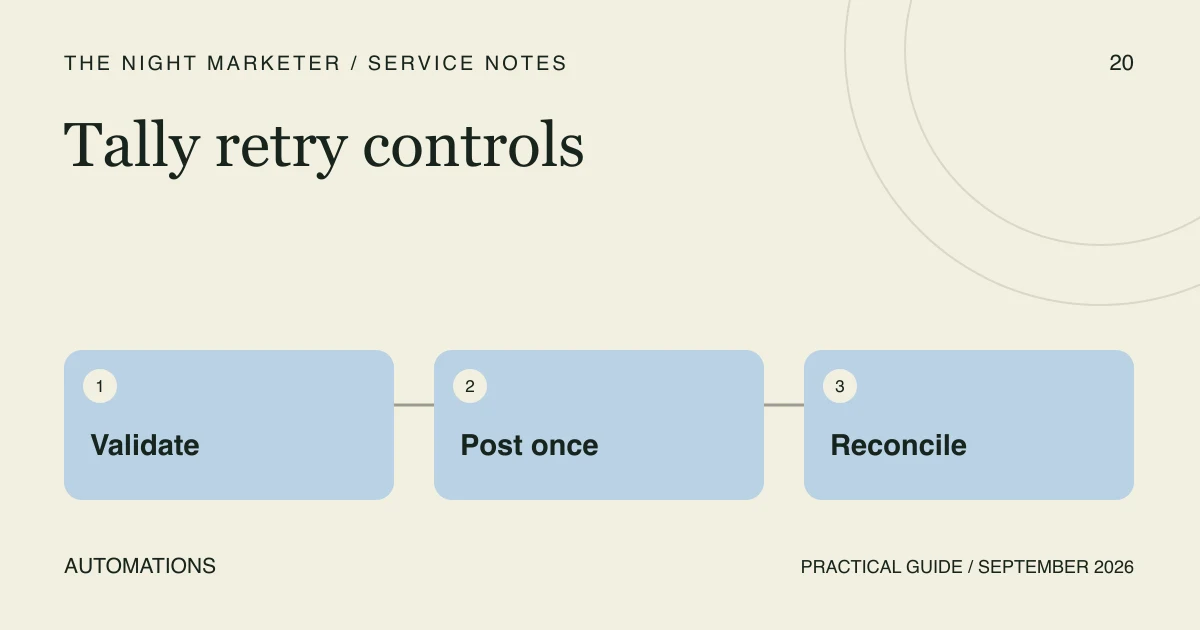
A connection returning a success code does not establish that the right company and ledger received the intended entry. Reconcile the resulting records against source counts and amounts.
Model total process cost
Include licensing or subscription charges, hosting where relevant, integration development, maintenance, training and exception handling. Request current written commercial terms for the actual edition and volume.
Avoid assigning a fixed saving without a measured baseline. An inexpensive connector can create substantial manual work if its failures are hard to diagnose.
Choose the clearer operating fit
Use a scorecard with required workflows, demonstrated evidence, gaps, owner and acceptance checks. Prefer the option the finance team can operate and review, with a supported recovery path.
See the separate Tally and Zoho Books bank reconciliation walkthrough.
Share your expected record volume, company structure and one redacted exception when you discuss accounting automation with TNM.
Frequently asked questions
Start with the system your staff can operate reliably. Confirm access to the company records, the required entry types and a way to recover uncertain results. Compare the same tasks on each shortlisted setup.
Run a few representative records for an approved company, including a missing mapping and an interrupted write. Compare the ledger or bill evidence, the exception owner and how the team confirms what posted.
Include the relevant licence, hosting, integration, support, training and handling of exceptions. Request current terms for the edition and record volume you expect.