In short
- Choose one profile use case and one activation destination.
- Preserve source identifiers, timestamps and matching evidence.
- Review uncertain identities and test incorrect-merge reversal.
- Propagate preference changes and reconcile downstream results.
Build a unified customer data platform by connecting sources, resolving identities and governing how profiles are used. A shared dashboard alone is not a CDP. Begin with a specific activation or analysis need, preserve source provenance and decide how uncertain matches, consent changes and profile corrections will reach downstream systems.
Define what the customer profile will be used for
Name the intended customer decision before selecting infrastructure. Marketing might need consistent audience eligibility, while service teams need a joined account history. Document the source systems and the information each use case truly requires.
A CRM manages customer-facing work, a warehouse can support analysis and a CDP centres on usable customer profiles and activation. Your implementation may combine these roles, but the responsibilities should remain explicit.
Preserve source identifiers and freshness
Ingest sources with their original identifiers, timestamps and lineage. Distinguish customer attributes from repeated activities such as orders or visits. Preserve source records so a disputed profile can be investigated.
Define freshness expectations per source instead of promising that all information is real time. A delayed payment update and a missing marketing event have different operational meanings and should not silently produce the same apparent customer state.
Deduplicate without forcing uncertain matches
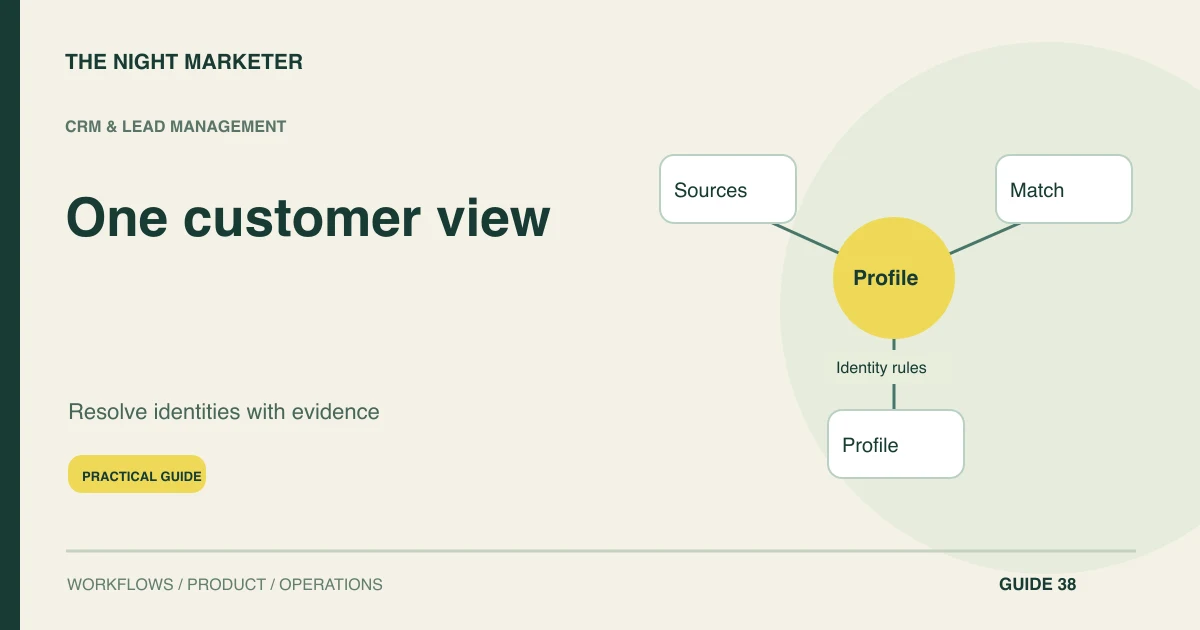
Deduplicate within each source before matching across sources. Prefer strong, appropriate identity evidence and document the rules used. A shared family phone number or general office email may represent several people.
Do not merge them solely because the string matches. Create a review route for ambiguous cases and retain enough provenance to undo an incorrect merge without losing the separate histories that existed before it.
Set field precedence and support corrections
Construct a profile view with field precedence and visible uncertainty. If sources disagree about an address or account relationship, define which source is authoritative for the intended action.
A profile can contain several valid addresses rather than one supposedly perfect value. Microsoft’s unification guidance describes source selection, deduplication, matching and a unified view; your business still needs to choose appropriate rules and accountable data stewards.
Design a minimum useful customer profile
Define the first profile around its use: source customer references, the chosen identity link, permitted contact details, relevant events and current activation eligibility. Keep supporting history outside that compact view when the use case does not need it. Use separate event timestamps so an old order arriving late does not appear to be a new purchase.
A unified profile is a governed view of evidence, not a reason to copy every available attribute. Start with one destination and trace both an identity correction and a preference change into it before onboarding further sources. This makes data quality observable where the profile is actually used.
Carry preferences into customer activation
Govern activation separately from profile matching. Finding two records that refer to the same person does not create permission to contact them through every channel. Carry relevant preferences, access boundaries and deletion requirements into downstream integrations.
Apply record-level authorisation to any interface that exposes profiles. Make it possible to explain why a customer entered an audience and to stop future activation when eligibility changes.
Measure false merges and downstream reliability
Evaluate the system through identity quality and useful downstream outcomes. Review false merges, missed matches, stale profiles and failed preference propagation. Reconcile profile counts and sampled histories with original sources.
Monitor the effect of rule changes before applying them broadly. Assign ownership for disputed identities and make changes auditable. A dependable customer view acknowledges uncertainty and correction; it should not conceal conflicts behind a single confident-looking record.
Identity and activation checks
Example: a shared phone number is not a shared identity
An illustrative retailer receives orders from a website, enquiries through a CRM and service records in another tool. Two customers share a telephone number. Instead of merging them automatically, the platform retains separate source records and asks for stronger evidence where the intended use requires it.
If a steward later corrects a merge, audience membership and relevant downstream links are recomputed. The test includes both joining known matches and reversing a deliberately incorrect one.
Prepare a first customer-data workshop
Bring a list of source systems and their owners, anonymised examples of a known match and a disputed match, the destination that will use the profile, and the required update frequency. Include the current preference rules and who can approve a merge correction. These inputs help distinguish a profile problem from a missing integration.
If the immediate need is moving orders or leads reliably between applications, begin with our CRM, ERP and marketing integration guide. A customer data platform adds a separate decision about identity, profile ownership and downstream eligibility.
Unify profiles around a usable customer decision
Start with a bounded source set, reversible identity rules and one activation destination. Discuss customer-data integration with TNM using the systems, matching evidence and correction requirements your business already has.
Frequently asked questions
Not always. If the CRM can meet the agreed profile and activation use case, extending its integrations may be enough. Compare its identity rules, correction workflow and downstream preference handling before adding a separate platform.
Yes. Start with a bounded set of sources and one destination. Agree the identity rules and acceptance examples first, then test disputed matches, correction and preference updates before adding more sources.
Keep the source records separate while the relevant owner reviews stronger evidence. A shared contact detail alone should not force a merge. Record the decision and keep the matching history available for later correction.
Bring source-system owners, anonymised examples of matching and conflicting records, the intended activation destination, update-frequency needs and the person responsible for disputed identities. Do not send real customer records through an initial contact form.