In short
- Agree company, voucher and ledger mappings before writing.
- Use a stable transaction key and prevent concurrent duplicate processing.
- Hold lost-response outcomes for reconciliation before replay.
- Keep destination references and an operator recovery trail.
In an illustrative Tally voucher automation scenario, the destination accepts a voucher but the integration loses the response. A blind retry risks creating a second entry. Record the source transaction, attempt and confirmed outcome so the operator can resolve this uncertainty.
Map the accounting contract
Agree which source event creates a voucher, the ledger mappings and the fields required for review. Validate company context, dates and amounts before attempting a write. Keep original references alongside transformed values. Confirm integration capabilities against the actual Tally version and deployment; do not assume every environment supports the same interface or configuration. Keep accounting endpoints on an appropriately protected network rather than exposing them publicly for convenience.
Design for ambiguous responses
Assign a stable source identifier and maintain a record of attempts and outcomes. Define how the system checks whether a previously attempted transaction already exists before retrying. A timeout is not proof of failure. Route uncertain outcomes for reconciliation rather than repeating writes indefinitely. Decide how corrections and cancellations relate to the original transaction so a modified source record does not masquerade as a new sale.
Reconcile before increasing volume
Test with a controlled company backup or approved test environment. Compare source counts and totals with the resulting vouchers and investigate every difference. Include invalid ledgers, duplicate messages, lost responses and an unavailable Tally instance in the test set. Set limits and alerts for repeated failures. The operational team needs a visible exception queue and a recovery procedure, not only a green integration dashboard.
Tally documents several integration methods and technologies. Confirm the supported method for the installed version. A transport choice does not itself provide source-system deduplication or reconciliation.
Test a controlled retry sequence
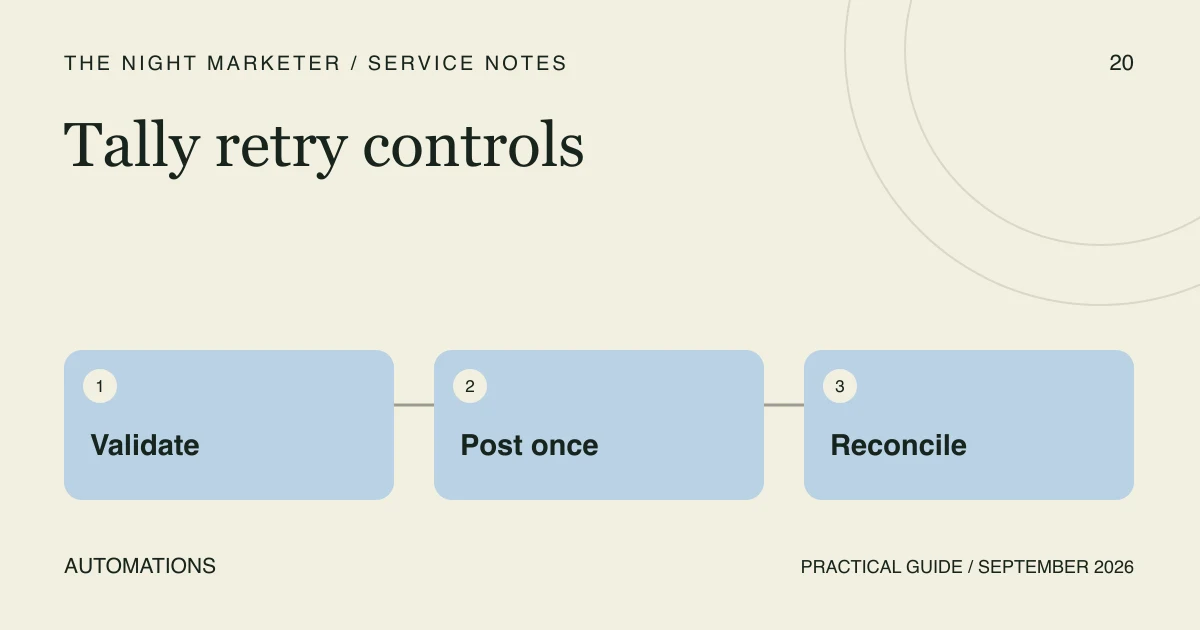
- Claim the source transaction. Give the transaction a stable key that includes the source system and company context. Prevent two workers from processing that key at the same time.
- Record the attempt. Save the intended voucher mapping and an attempt reference before sending. A repeated request for the same transaction must reach the same processing record.
- Record a confirmed result. Validate the application-level response for the installed interface and retain the destination reference when available. A connection or HTTP success alone cannot confirm correct accounting entry.
- Hold an uncertain outcome. If the response is lost, mark the attempt for reconciliation. Check the destination using the agreed references and documented lookup process before authorising another write.
- Recover with an audit trail. An operator records what was found and why a retry or correction is approved. Keep bounded retry attempts and a pause control.
These are integration design controls. Verify the exact fields, lookup capabilities and import responses in the installed Tally version. Do not assume the transport provides an automatic duplicate-prevention guarantee.
Illustrative example: a repeated order export
If an order export runs twice, the same source order should not be treated as two independent sales. The precise deduplication mechanism must be designed and tested for the integration; a filename or a successful HTTP status alone is insufficient evidence.
Specify a recoverable Tally integration
Bring the Tally version, company setup, ledger mapping and an anonymised sample of a failed export to the first review. For the broader ecommerce workflow, read our Shopify-to-Tally integration guide. The Night Marketer can help scope this work through our Tally automation.
Frequently asked questions
Validate the interface’s application-level result and reconcile the destination reference, company, amount and source transaction. Check the response format for the installed integration method.
Pause automatic replay for that transaction and check whether a matching voucher already exists using the agreed references. Record the check and its outcome before authorising another write.
Link a correction to its original source transaction and route it through the accounting team’s approved process. Preserve history so an amendment cannot silently become another sale.