In short
- Replace one workflow with a clear owner and boundary.
- Verify the expected outputs using representative cases.
- Reconcile records and rehearse recovery before rollout.
- Check dependencies before retiring the old workflow.
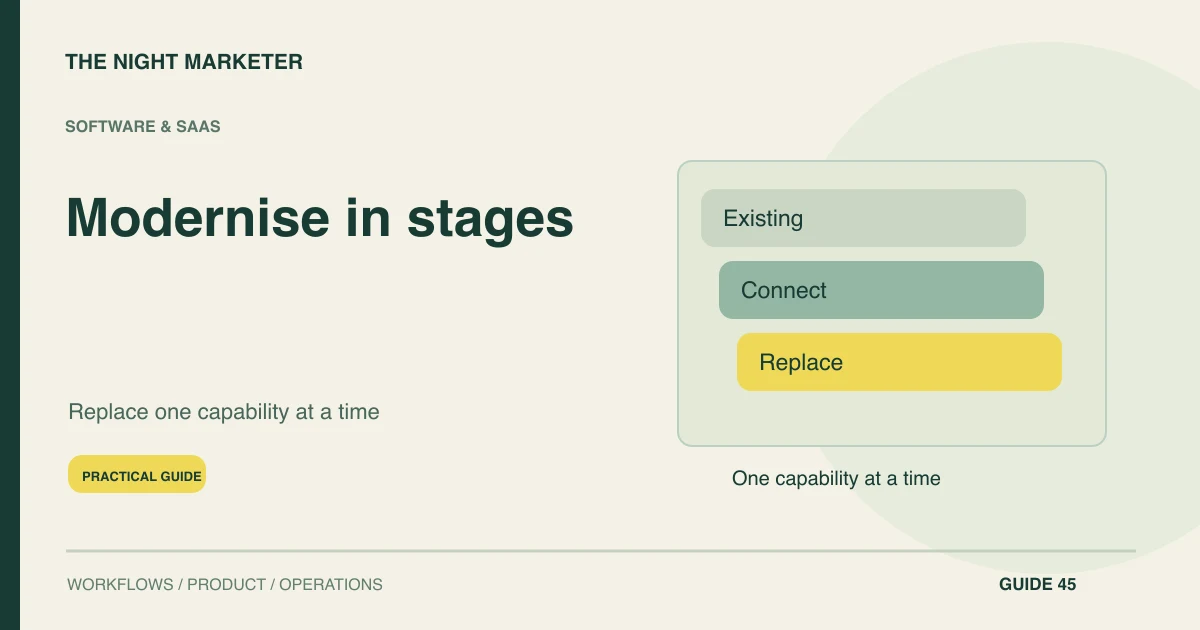
Start a legacy software upgrade with one workflow that has a clear business owner and records you can check. Decide how the old workflow behaves, which parts should change and how the team will recover records created during the cutover.
Choose a workflow with a clear boundary
Describe the constraint in terms people can test. An unsupported dependency or repeated manual work may justify beginning with quotation entry while retaining the ledger. List the users, integrations, scheduled jobs and reports that consume the workflow’s records. Name the authoritative system for each record before and during the change.
The Strangler Fig pattern describes replacing parts of a legacy application incrementally and routing requests to the old or new implementation. Use it where the chosen workflow has a boundary you can operate during the transition. Microsoft’s phased migration guidance.
Write the examples the replacement must pass
Ask the people who run the workflow to show ordinary transactions, corrections, invalid inputs and unusual states. Record the expected outputs and downstream records. Agree which old behaviours are intentional and which the business wants to change. Keep reference examples in a controlled test environment.
Use AI assistance to suggest candidate dependencies or missing tests where your code and data rules permit it. Ask a maintainer to verify any proposed dependency and run the test with the expected results. GitHub’s guidance on AI coding assistance.
Reconcile important records during the pilot
Illustrative quotation upgrade. A team moves quotation entry to a new application while keeping the old ledger. Its test set includes a revised price, a declined quote and an accepted quote that creates a downstream order. Compare record identifiers, values and processing outcomes for those cases. Give the finance owner a way to review discrepancies and record intentional differences.
Plan for the records created after cutover
- State the condition that pauses new traffic and who can make that decision.
- Document which application should accept new writes and where a reviewer can see records created since cutover.
- Rehearse recovery for accepted, queued and uncertain transactions. Specify which need correction or replay.
- Decide what proves the old workflow can be retired. Review dependent jobs and reports before removing access.
Use the API-first architecture guide to define the interface between systems. Bring one workflow, example records and the hardest recovery case to TNM’s custom software development team.
Frequently asked questions
Choose one with a clear business owner, an identifiable set of files or records, a manageable number of dependencies and observable acceptance criteria. Document the systems it must continue to work with.
It can suggest interpretations of supplied code or candidate tests. Verify each finding with a maintainer and representative transactions before it informs the migration.
Plan how to restore the working route and account for records created after cutover. Rehearse which records need reconciliation, correction or replay. Decide who can pause traffic and who signs off recovery.
Include the workflows tested, reconciled records, known exceptions, expected differences approved by the business owner and the support plan. Record any remaining dependencies before retiring the old path.