In short
- Define business operations and their consumers before designing endpoints.
- Agree validation, errors, compatibility and retry behaviour in the contract.
- Enforce record permissions on the server and keep long-lived secrets off clients.
- Test real consumers and measure runtime limits separately from the API document.
API-first architecture defines the contract between application components and consumers before relying on a particular interface implementation. It can make integrations and independent product changes easier to manage. It does not automatically improve runtime performance: database design, permissions, resource limits and failure handling still need their own implementation and measurement.
Define business operations and API consumers
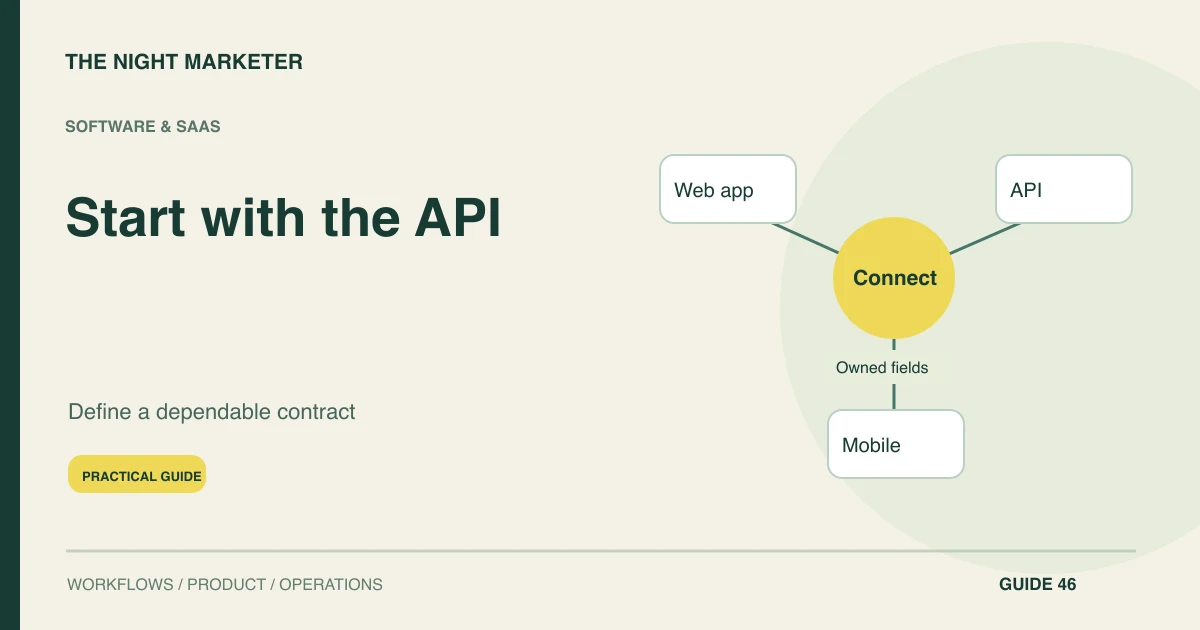
Identify the consumers and business operations the API must support. A mobile app, customer portal and internal tool may share an order concept but need different permitted views and actions. Define the outcome and owner for each operation.
Avoid exposing internal database tables simply because they exist. The contract should express a useful business capability whose meaning can remain stable when the underlying implementation changes.
Agree requests, responses and errors
Describe requests, responses, validation and errors explicitly. OpenAPI provides a standard format for HTTP interface descriptions. Agree required fields, identifiers, pagination and expected failure states with the consuming teams.
Use examples that include invalid and missing data. A contract document is a starting point for implementation and testing, not proof that a consumer can safely assume every response is correct or that every optional field will always appear.
Protect compatibility as the API changes
Plan compatibility rather than changing shared fields without coordination. Distinguish an additive response field from a changed meaning or removed operation. Identify consumers, communicate deprecation and test representative requests before release.
Keep a documented migration path for necessary breaking changes. Version numbers alone do not protect an old client if the server changes behaviour underneath it or if the same field starts representing a different business concept.
Design record access and safe retries
Build authorisation and duplicate prevention into the operation design. Check who may act on each requested record. For an operation that creates an order or starts another consequential workflow, specify how retries relate to the original request.
Keep server credentials and long-lived secrets off mobile and browser clients. Validate each request on the server. An API used by a trusted frontend is still reachable outside the interface, so its permission checks cannot depend on a hidden button or a cooperative client.
Measure runtime limits separately from contracts
Measure runtime behaviour against the intended workload. Review database queries, response sizes, caching rules and resource consumption. Set timeouts and operational limits that suit the task.
A published contract cannot compensate for an unbounded report query or a slow dependency. Define what the consumer should do when the operation is temporarily unavailable, and avoid making every interface wait for a long chain of unrelated synchronous calls.
Scale the change process as well as request volume
An API helps separate consumers from implementation details, but only when its meaning stays dependable. Keep a small catalogue of operations, their owners and the clients using them. Measure compatibility failures as well as latency.
Use the CRM, ERP and marketing integration guide to work through field ownership and event handoffs alongside the API contract. Creating an order and reading invoice state are different responsibilities. They can live in one maintainable application; an API-first approach does not require a separate microservice for every endpoint.
Test consumers and operate the API over time
Test with actual consumers and operate the contract over time. Include meaningful integration tests, failure cases and permission boundaries. Monitor request errors and latency alongside the business outcome, such as an order being accepted once.
Assign someone to review proposed contract changes. API-first design can support a modular application without requiring microservices; choose deployment boundaries from operational needs and team capacity rather than treating distributed services as a necessary badge of scale.
API acceptance checks
| Area | What to test | Acceptance evidence |
|---|---|---|
| Contract | Run valid, missing-field and invalid requests | Responses follow documented validation and error meanings |
| Compatibility | Use an older consumer against the changed service | Supported behaviour remains compatible or has a migration path |
| Authorisation | Request a record outside the caller's access | The API enforces permission without relying on the frontend |
| Runtime | Apply the intended data volume and dependency failure | Latency, limits and recovery match the task's requirements |
Illustrative example: one order contract for web and field apps
In this illustrative design, not a client case, a business exposes an order request operation used by both its web portal and field app. The contract defines the customer reference, permitted items, duplicate-request behaviour and pending state. The field app can queue a request during an outage without assuming stock is reserved.
Later, the backend implementation changes, but the agreed external behaviour remains compatible. Tests verify both consumers and their access restrictions before the change is released.
Define stable business operations first
For a first architecture discussion, bring the current consumers and supported versions, redacted request and response examples, field owners, record-access roles and one workflow that fails today. Include actual workload information where available. Choose one business operation and agree its acceptance checks before estimating a wider integration.
Use contracts to support compatible change, then measure runtime performance independently. Discuss API and integration architecture with TNM using the intended consumers, workload and failure cases.
Frequently asked questions
Start with a business operation that needs a stable interface. Document its current behaviour and consumers, then introduce a contract and compatibility tests around that boundary. A full rebuild is not a prerequisite; the scope depends on the existing system and access to its integration points.
No. A modular application can expose well-defined APIs from one deployment. Choose service and deployment boundaries from operational needs and team capacity, rather than creating a separate service for every endpoint.
A timeout does not prove that the operation failed. The contract should define retry rules, any supported duplicate-request protection and how to check a pending result. Confirm the actual API behaviour before retrying a consequential action; do not assume every provider supports the same mechanism.
Bring the applications and supported versions that will consume the API, redacted payload examples, field owners, access roles, expected workload and a workflow that currently fails. Agree the first operation and acceptance evidence before estimating the wider project.