In short
- Define supported tasks and a clear completion result.
- Retrieve approved knowledge within each user's permissions.
- Keep credentials and record-changing actions behind the backend.
- Test interruption, uncertain results and human handover.
Build an AI chat assistant for your mobile app around a small set of supported tasks, approved knowledge and authorised actions. Keep model credentials on the server, give answers a dependable source and provide correction or human handover when the assistant cannot resolve a request. Start by proving answer quality and permissions before enabling consequential tool actions.
Define the questions and actions the assistant supports
Define what the assistant should help the user accomplish. Answering a policy question, explaining an appointment and changing a booking are different capabilities. List the supported tasks, required records and completion conditions.
Make the scope understandable in the interface. A general chat box without clear boundaries can invite requests the application cannot fulfil, leaving users uncertain whether the assistant has explained an option or actually performed an action.
Prepare approved, current knowledge
Prepare approved knowledge with ownership and update rules. Keep source documents and operational records distinguishable, and retrieve only information the current user may access. Retain enough context to cite an important policy or account detail.
Test missing and conflicting material. If the evidence does not answer the question, the assistant needs a useful next step rather than a prompt that encourages it to improvise a confident policy.
Keep credentials and record permissions on the backend
Place provider credentials and privileged tools behind an authenticated backend. Verify the user’s right to each requested record and action outside the model. Do not trust a customer ID or tool argument merely because it appears in generated output.
Scope any retrieval to the authorised account. Rate limits, usage controls and logging should support operations without collecting unnecessary sensitive conversation data or exposing credentials in the mobile binary.
Treat retrieved instructions as untrusted input
Treat user messages and retrieved content as untrusted input. A document can contain text that tries to redirect an assistant away from the user's intended task. OWASP’s prompt-injection guidance supports layered defences, but a clever prompt alone is not an access-control mechanism.
Keep tool permissions narrow, validate arguments and require suitable confirmation for consequential changes. An answer should never become authority to bypass the application's normal rules.
Handle interruption, retries and human handover
Design the mobile conversation for interruptions. Show whether a request is in progress, cancelled or completed. Preserve a useful draft when the connection fails, and avoid treating a repeated request as permission to perform the same action again.
Offer a clear route to a person with relevant context. For offline use, distinguish locally available information from features that require a server; do not promise a general assistant works without connectivity.
Keep conversation state separate from business state
A message saying an action is complete should follow a confirmed backend result. Store the operation reference so the app can check progress after a timeout or reconnection. A long streamed answer must not conceal a failed booking or account update.
Let the user cancel an answer without implying that an already accepted business operation has been reversed. Record the supported task, approved knowledge version and action result for diagnosis, using only the conversation data the operating policy permits. These details make an assistant understandable to users and support staff without giving generated text authority over the application's records.
Evaluate answers and actions before expanding access
Evaluate both answers and actions with representative cases. Include routine questions, missing policies, another customer's record, misleading content and a failed tool. Check answer accuracy, appropriate refusal, task completion, latency and cost per useful result.
Start with read-only or draft behaviour where possible. Expand authority only when the application can demonstrate permissions, recovery and an operational owner who can pause the feature when quality deteriorates.
Illustrative example: rescheduling an appointment safely
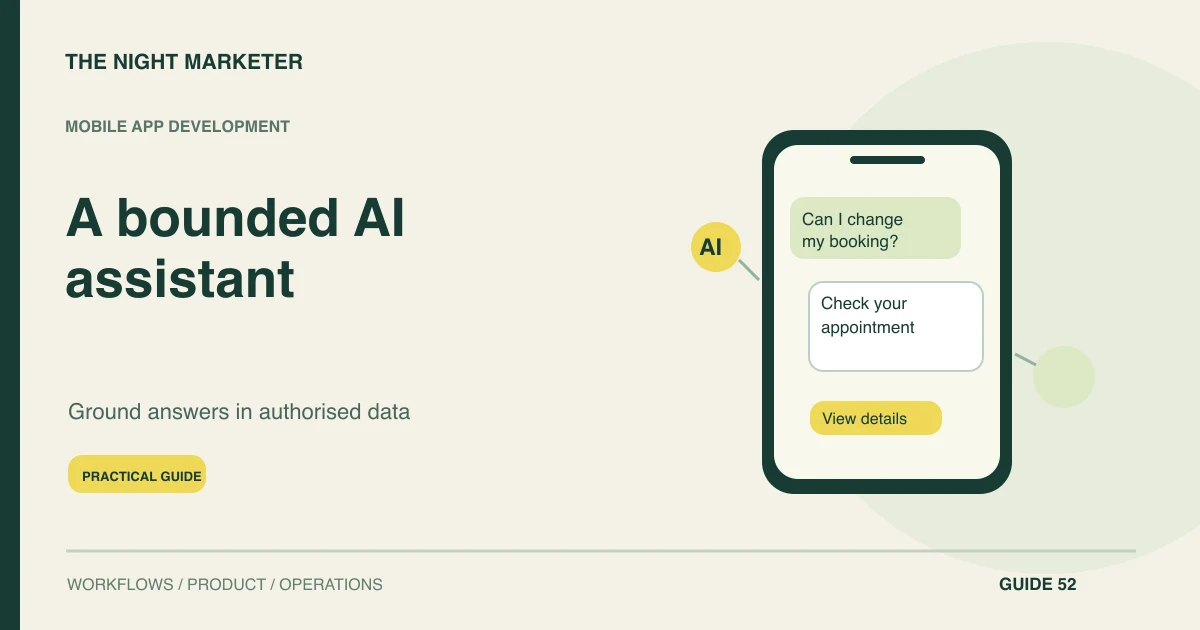
Consider an illustrative appointment-booking app. A customer asks to change an appointment. The assistant retrieves the permitted appointment, explains available options and prepares a request. The backend checks current availability and the user's permission before confirming a change.
If a timeout occurs, the interface checks the request status before retrying. A test also asks about another customer's booking and places misleading instructions in a retrieved note; neither should grant access or bypass the normal confirmation flow.
Bring a practical mobile-assistant brief
For a first discussion, bring the current app and backend architecture, one or two supported tasks, approved knowledge owners, anonymised request examples and the human handover route. Include the required languages, expected usage and response-time needs. These inputs guide scope and operating-cost estimates; a chat screen alone does not define the work.
If users mainly need to find products or content, compare that need with AI search and recommendations for mobile apps. A task-based assistant also needs conversation state, permissions and a clear completion result.
Start with a bounded assistant users can trust
Prove approved answers and authorised actions before expanding the scope. Discuss a mobile assistant with TNM using supported tasks, knowledge sources and the required handover path.
Frequently asked questions
Often, the assistant can be added to an existing app if its authentication, backend interfaces and release process support the intended tasks. Review those dependencies first; missing access controls or unsupported APIs may require backend changes even when the app screens stay familiar.
Choose a small set of useful questions with approved answers and a clear handover route. Start with read-only or draft tasks, then consider record-changing actions after permissions, confirmation and recovery have passed agreed tests.
Cloud-based answers need a working connection. An explicitly designed on-device feature or cached reference material is a separate capability. Label what is available offline and test reconnection without treating a repeated request as a new business action.
Share the existing app and backend architecture, intended tasks, knowledge owners, required languages, expected usage and handover process. Use anonymised examples in early discussions. Model usage, retrieval, integration and evaluation all affect scope and ongoing costs.