In short
- Validate a repeated user task and its business purpose.
- Prototype the hardest device or integration dependency.
- Include recovery, support and acceptance in the MVP.
- Expand after pilot evidence identifies the next constraint.
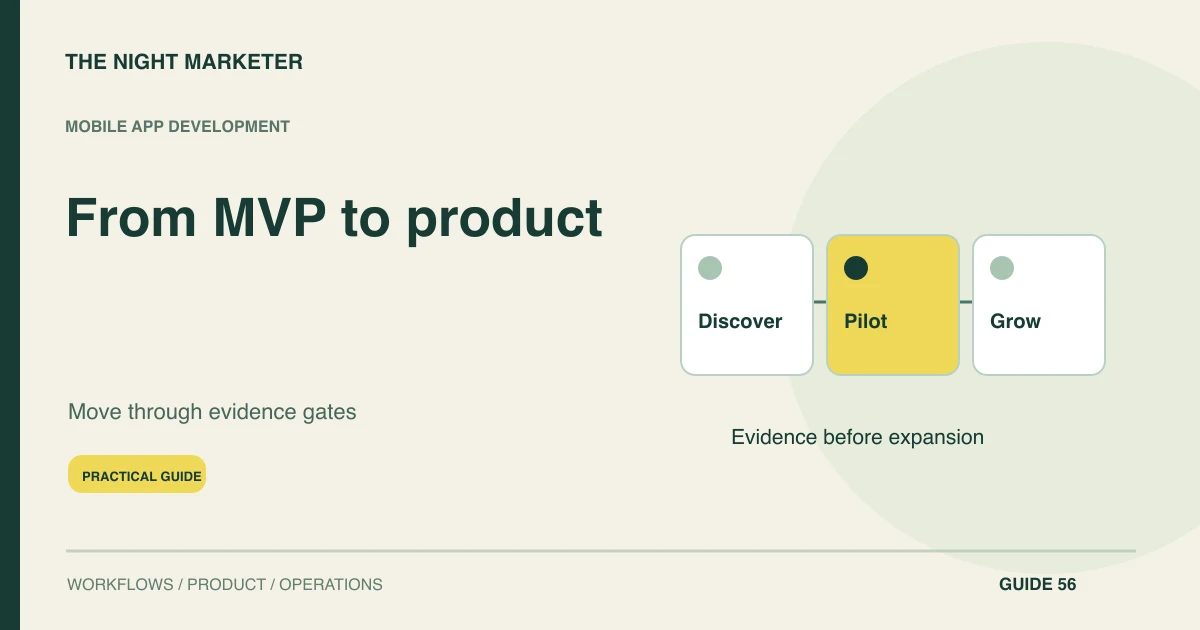
A practical mobile app roadmap moves through discovery, a focused prototype, a supported MVP, public release and measured expansion. Each phase should resolve a specific uncertainty and have an acceptance gate. Set timing from scope, integrations and evidence rather than assuming every app can follow the same launch schedule or scale plan.
Validate the user problem and business purpose
Define the user problem and the buyer's reason to invest. Observe the current task and identify the friction an app could remove. Consider whether an existing tool or web journey could meet the need.
A mobile product should have a reason to exist beyond being another channel. Agree the target devices, business owner and outcome measures early, so the team can test the intended value rather than simply completing a feature list.
Prototype the highest-risk device or integration
Prototype the highest-risk journey. If the product depends on a scanner, background work or offline reporting, test that behaviour before polishing secondary screens. Use representative devices and realistic information.
A clickable design can test comprehension, while a technical proof can test integration feasibility; neither replaces the other. Document the uncertainty each prototype is meant to resolve and what result would change the plan.
Scope the MVP as one complete task
Scope the MVP as a complete narrow task. Include the necessary account, permission, data and correction paths, not only the main screen. Define acceptance in observable terms.
A field report might need to preserve entered work through a connection interruption and identify whether submission is pending or accepted. Defer unrelated modules so the first release can be evaluated, but do not defer essential integrity or recovery behaviour that the core task depends on.
Observe the supported pilot
Run a supported pilot with people who perform the actual job. Instrument activation, completion, errors, latency and requests for help. Ask users to demonstrate confusing or failed cases.
Watch whether they retain a private spreadsheet or alternative app to finish the process. That behaviour can expose missing capabilities. Give the pilot a support owner and an escalation route, then use its evidence to revise scope and operating assumptions.
Prepare distribution, recovery and old-client support
Prepare release and recovery responsibilities. Confirm deployment access, signing ownership, privacy information, monitoring and support arrangements appropriate to the product. Check current distribution requirements during release preparation rather than relying on remembered rules.
Test restoration and a rollback route for relevant components. Separate the ability to ship an update from the ability to support users already on an older version, especially where backend interface contracts and queued work must remain compatible.
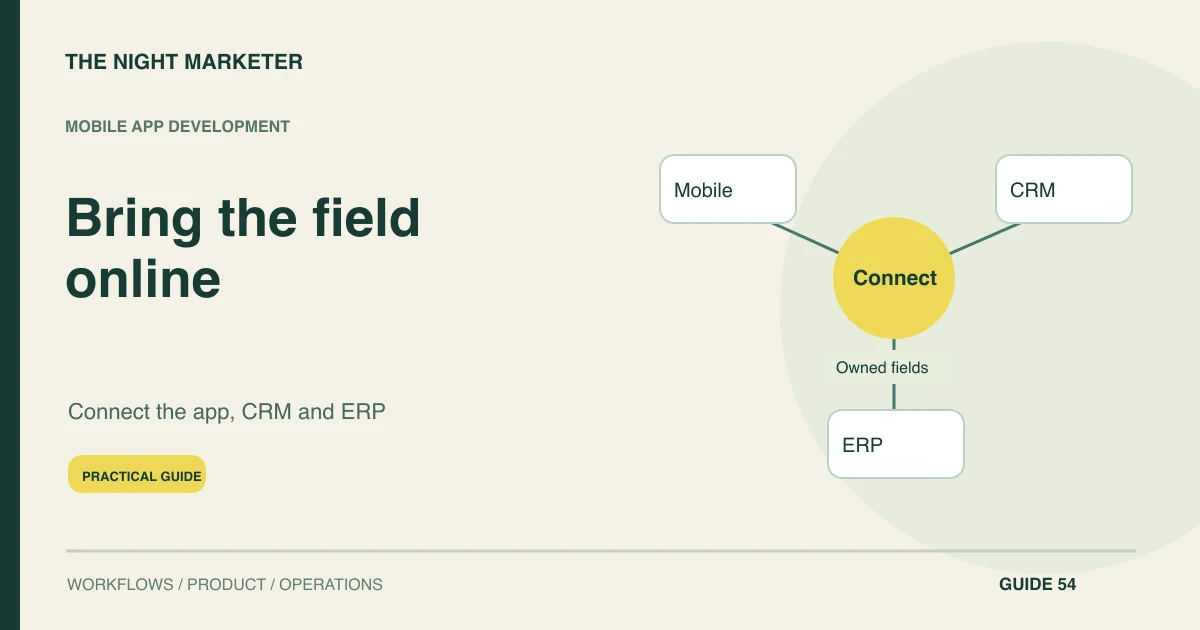
If the MVP must use existing sales or operations data, review how a mobile app connects with CRM and ERP before estimating that dependency.
Budget the work between the milestones
Discovery, design, development, data preparation and operations overlap, but each needs an accountable owner. Keep a small evidence log showing what changed the plan and why. TNM's Raftaar app-delivery case study is a relevant example of a product journey connected with a launch foundation; it does not set a universal MVP schedule.
Your roadmap should name the next uncertainty to resolve, the people needed and the evidence required to proceed. Separate postponed features from essential release work so the team does not launch a fragile core task just to meet an arbitrary feature-count milestone.
Expand from measured product and operating constraints
Scale the bottlenecks that have been measured. Review repeated use, customer outcomes, support burden and infrastructure behaviour together. Improve an expensive query, slow onboarding step or unreliable sync before adding architectural complexity.
Define evidence gates for further investment. Product scale includes the team's ability to handle incidents and change safely; a larger deployment is not sufficient if the underlying task remains hard to complete or expensive to support.
Evidence gates for the roadmap
| Area | What to test | Acceptance evidence |
|---|---|---|
| Discovery gate | Demonstrate the current user task and problem | The product has an observable purpose and business owner |
| Prototype gate | Prove the hardest device or integration dependency | Important feasibility assumptions have been tested |
| MVP gate | Complete one narrow job including failure recovery | The intended user receives a real supported result |
| Expansion gate | Review repeated use and operating bottlenecks | Further scope and infrastructure follow evidence rather than speculation |
Example: stabilising report uploads before expansion
An illustrative inspection app pilots one report workflow before adding scheduling and billing. The first gate checks that a technician can finish a report through a connection interruption and that support can trace a failed submission.
The pilot reveals unclear photo-upload state, so the team fixes that before expanding. Later infrastructure changes are justified by measured upload and processing constraints, not by an unsupported promise that the MVP will serve any future user volume.
Give every roadmap phase an evidence gate
Advance when the next important uncertainty is resolved and the core task remains supportable. Discuss an MVP and rollout roadmap with TNM using the target journey, dependencies and pilot measures.
Frequently asked questions
Bring the main user task, intended devices, current tools or APIs, sample workflows and any existing designs. Explain who owns the product, which business result matters, and the budget or deadline constraints that the team must assess.
It can when supported interfaces expose the required records and actions with appropriate access controls. Confirm those dependencies during discovery. Include authentication, unavailable-system behaviour and data ownership in the estimate rather than treating integration as a final connector task.
The estimate depends on the user journeys, supported platforms, device features, integrations, data preparation, release requirements and support scope. Discovery should identify assumptions and exclusions so changes can be assessed against an agreed scope.
Agree account ownership, signing access and release responsibilities before development. Use organisation-controlled accounts where appropriate and document how the client can maintain access, authorise releases and receive the source code, documentation and operational handover specified in the contract.