In short
- Compare specific tools, hosting arrangements and team responsibilities.
- Give each option the same workflow and integration failure to demonstrate.
- Include recurring costs and the effort of ordinary maintenance.
- Test data export and an independent deployment before committing.
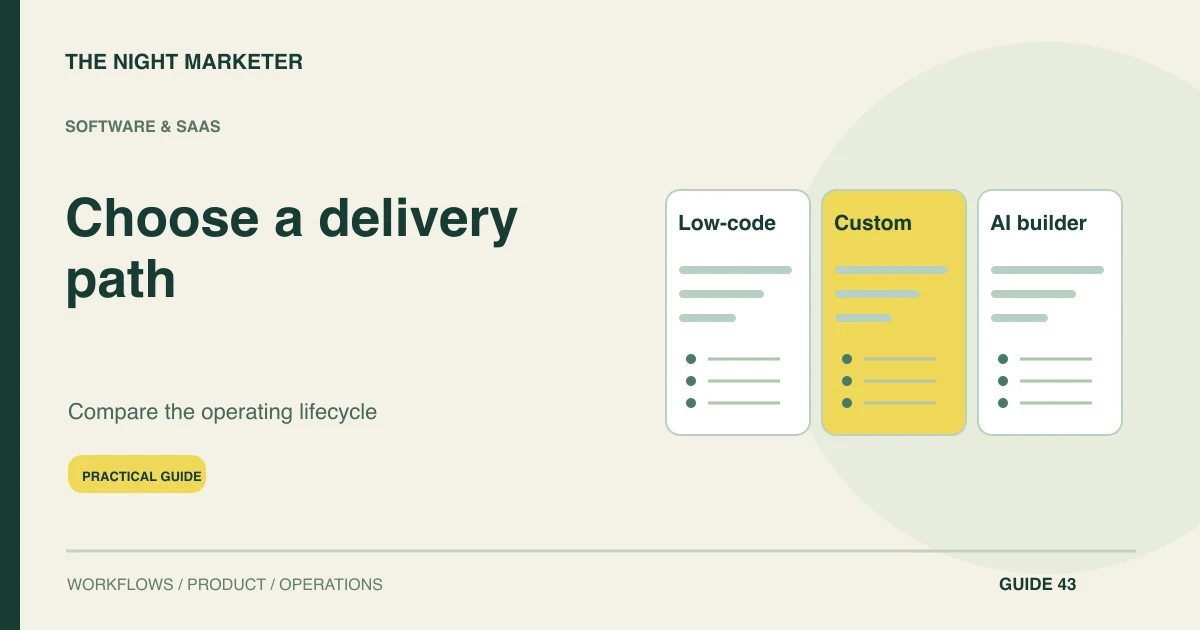
Compare low-code, custom development and AI app builders against the application your team must operate after the first demo. The categories overlap: AI builders can generate conventional code, and custom systems can use managed components. Choose the approach that passes your requirements for workflow, integration, permissions, maintenance and portability.
Understand where the three approaches overlap
Define the categories without assuming they are mutually exclusive. Low-code platforms provide configured components and workflows. Custom development gives a team responsibility for implementing the application.
AI app builders assist with creating or changing parts of a solution, with different degrees of code and hosting control. Identify the actual product and deployment arrangement being proposed. Labels alone do not tell you who owns releases or how the system can be maintained.
What each approach must demonstrate
Compare the same production requirements
Give each option the same acceptance scenario. Include representative records, a restricted role, an integration failure and a required correction. Ask for demonstrated behaviour rather than a claim that something can be added later.
A simple internal request form differs from a multi-tenant customer portal. Rank essential requirements before testing, and distinguish supported configuration from a fragile workaround that will need attention whenever the platform changes.
Check connector coverage and data ownership
Check integrations and data ownership early. Determine whether the intended edition supports the required connector, API access, refresh pattern and event coverage. A connector that reads a record may not support the necessary write or recovery path.
Preserve source identifiers and test export relationships. If a platform limits the task, consider a small conventional service around it before deciding the entire application must be replaced.
Test security, recovery and controlled releases
Test permissions beyond the interface. Verify record-level access, server-side validation and background jobs.
A hidden button is not sufficient protection for an API action. Include backup restoration, release rollback and a change made by someone other than the original builder. Microsoft’s low-code lifecycle guidance includes governance, testing and maintenance; choosing configured components does not remove those responsibilities from the business.
Price operation and verify portability
Compare operating cost and portability over a shared period. Include users, runtime, required connectors, storage, support and expected changes. For an AI-generated codebase, check what can be exported and whether another team can build and deploy it.
For a managed platform, inspect the actual data export and configuration handover. Ask the team to restore representative records and deploy a copy from the handover package. Microsoft Power Platform solutions contain components and configuration. Export business records through the platform’s separate data workflow and verify how to restore them.
Distinguish a disposable prototype from an operating application
A prototype can be valuable even when it will not become the production codebase. State that boundary early and budget for whatever must be rebuilt or validated. An operating application needs a reproducible release, recoverable data and someone who can investigate a failed job.
For a concrete business-process example, consider the connected records in TNM's custom order-management CRM. Demonstrate that same class of workflow in each shortlisted product. Record where an approach passes the workflow test and where it needs more work.
Choose a pilot with an exit route
Choose a limited pilot with a clear exit route. Low-code may fit a stable internal workflow; conventional development may fit a necessary unusual capability; an AI builder may help prove a concept or accelerate a supported implementation. These are hypotheses to test, not universal rankings.
Document the unresolved requirements and the person who owns each one. Expand only after intended users can complete the task and the operating team can handle changes and failures.
Example: comparing a customer request portal
An illustrative company needs a customer request portal with manager-only approvals and an accounting update. Each candidate must demonstrate account isolation, approval history and recovery when the accounting connection fails. The pilot also exports customer records and restores a backup.
If a fast builder cannot yet demonstrate those steps, record the additional work. The winning option is the smallest maintainable approach that passes the essential scenario, regardless of how the initial interface was created.
Choose an approach you can operate
Compare demonstrated workflow fit, continuing cost and a tested exit route. Discuss the build approach with TNM using the same requirements pack for low-code, AI-assisted and conventional options.
Frequently asked questions
A low-code tool can include AI-assisted configuration. An AI app builder can generate code that a developer maintains. Compare how the specific product is hosted, changed and supported.
Give each shortlisted approach the same realistic workflow, allowed user roles, representative records and recovery scenario. Ask the team to show the result and the work still required.
Yes. Agree who can test, approve and deploy a change. Verify that someone besides the original builder can release the next version and recover when an integration fails.
Verify that business data, permissions, connectors and deployment instructions are available too. Ask the receiving team to restore a small dataset and complete a deployment independently.