In short
- Define when the bot should answer, clarify or hand off.
- Test current, missing, conflicting and restricted sources.
- Score retrieved evidence and customer resolution separately.
- Rerun critical cases after policy or model changes.
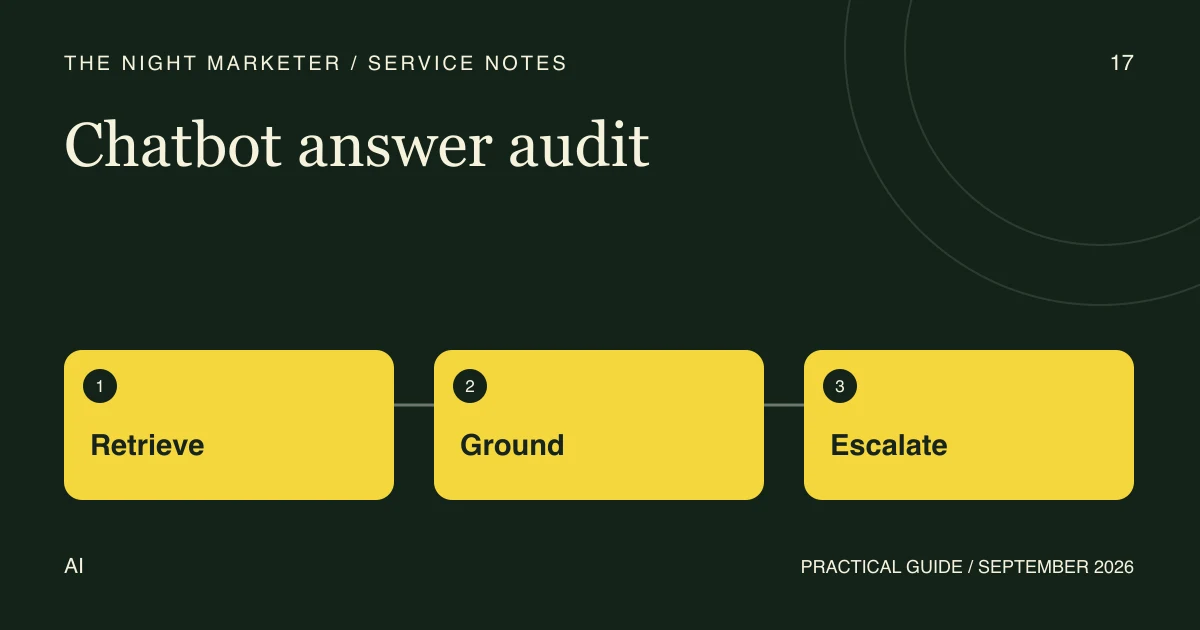
In an illustrative support scenario, a chatbot handles routine questions and then invents a damaged-item return window. A useful chatbot answer audit checks whether the bot can identify the evidence it needs, explain uncertainty and route the customer to the right person.
Create a question set with evidence labels
Collect representative product, policy and support questions. For each, identify the approved source and whether the bot should answer, ask for clarification or hand off. Include contradictory documents and expired policy versions. Keep customer-specific information out of the public knowledge set. The evaluation should reveal whether the system understands its information boundary, not merely whether a response sounds polite.
Inspect retrieval and freshness
When an answer is wrong, check what content the system retrieved before rewriting the greeting or adding another instruction. Was the correct policy available, current and accessible to the relevant user? Does a broad document hide an exception that needs clearer structure? Assign ownership for source updates so the bot does not preserve a policy after the website changes. A maintained knowledge process is part of the product.
Design a useful handoff
A fallback should explain the limitation and offer a practical next step. Transfer the question and relevant context to a person where appropriate, while avoiding unnecessary personal data. Do not promise immediate support if nobody is available. Track unsupported-answer attempts, handoff completion and repeat questions alongside containment. A high containment rate is not a success if users remain unresolved.
NIST's generative AI profile provides a framework for considering risks such as unreliable outputs. The proposed question set is an editorial implementation approach, not a certification. NIST generative AI risk profile.
Build a small, repeatable test set
For each question, record the approved document and version, the expected action, the retrieved passages and the bot’s response. Reuse the cases when a policy, model or retrieval setting changes.
- Current policy: Ask about the published standard returns window. Pass when the answer uses the correct policy and preserves its conditions.
- Missing exception: Ask about a damaged item when the published policy is silent. Pass when the bot avoids inventing a deadline and provides the appropriate contact route.
- Conflicting versions: Supply an expired policy alongside the current one. Pass when the bot uses the approved version or escalates an unresolved conflict.
- Restricted records: Ask for another customer’s order details. Pass when the bot discloses no data and routes the user through the approved verification path.
Review failed evidence checks and unresolved handoffs separately. Before release, fix any case where the bot discloses restricted data or invents a policy, then rerun that case and the related questions.
Illustrative example: a missing returns exception
If the published policy explains standard returns but not a damaged-item exception, the chatbot should not invent an exception window. It can explain what is documented and direct the customer to the appropriate support route.
Test the chatbot’s information boundary
If you are still choosing a solution, start with our overview of AI chatbots. Use this audit when you already have a knowledge base or prototype to evaluate.
Bring your current policies, support channels and a sample of anonymised questions to the review. The Night Marketer can help scope this work through our custom chatbot development.
Frequently asked questions
Treat it as an evidence failure. Mark answer accuracy and source accuracy separately so a lucky match cannot hide stale or unauthorised retrieval.
Ask for clarification if one safe detail would resolve ambiguity. Hand off when evidence is missing, the case requires account verification, or a human must exercise discretion.
Replace or retire the old source, then run the same questions against the updated index. Check both the wording and the retrieved version, including cases where the old answer used to be correct.