
In short
- Static pricing ignores real-time market data, consistently sacrificing potential revenue and margin.
- The core challenge is balancing algorithmic profit maximization with customer trust and perceived fairness.
- Your AI model's accuracy depends entirely on robust internal, competitor, market, and customer data.
- Ethical guardrails like price floors and change limits are essential to protect brand equity.
- Measure success with a balanced scorecard of margin, revenue, competitive position, and customer metrics.
- Always start with a controlled pilot on a limited product set to de-risk implementation.
- AI dynamic pricing is an ongoing strategic process, not a one-time "set and forget" tool.
In today’s hyper-competitive e-commerce landscape, the price tag is no longer just a number. It’s a dynamic signal of value, demand, and strategy. AI dynamic pricing is the transformative engine that turns static numbers into a powerful profit lever. Yet, without a strategic framework, it risks eroding the very customer trust you’ve worked to build. This guide demystifies the process, offering a clear path to implementation that balances revenue with relationship.
Ready to move beyond guesswork? Partner with The Night Marketer to architect an AI-powered pricing system that maximizes revenue while fortifying customer loyalty.
Introduction: The Promise and Peril of AI Pricing
AI dynamic pricing promises a new frontier of profitability. It uses algorithms to adjust prices in real time based on market signals. The potential is staggering: optimized margins, competitive wins, and maximized inventory turnover. However, the peril is equally real. Poorly executed AI pricing can alienate customers, trigger price wars, and damage brand equity. This guide exists to help you capture the promise while expertly navigating the peril.
Why Static Pricing is Leaving Money on the Table
Static pricing operates in a vacuum. It ignores the fluid realities of customer demand, competitor actions, inventory levels, and market trends. You lose revenue during peak demand by not raising prices modestly. You also sacrifice margin by not lowering prices to clear slow-moving stock. In a digital world, a fixed price is an economic inefficiency. It leaves profit on the table every single day.
The Core Challenge: Maximizing Profit vs. Maintaining Trust
The central tension of any AI dynamic pricing strategy is this dual objective. Your algorithm seeks to maximize profit based on data. Your brand, however, must maintain perceived fairness and customer loyalty. The winning strategy isn't about charging the highest possible price; it's about charging the optimal price. This balance is the difference between short-term gains and long-term, sustainable growth.
How AI Dynamic Pricing Actually Works: A Non-Technical Breakdown
Forget complex code. Think of AI pricing as a super-informed, tireless pricing manager. It continuously analyzes multiple data streams. It then predicts the ideal price point to achieve a specific goal, like maximizing revenue or clearing inventory. The AI doesn't "set" prices arbitrarily; it executes a strategy you define. It learns from outcomes, constantly refining its models for better future decisions.
Building Your AI Pricing Foundation: The 4 Essential Data Pillars
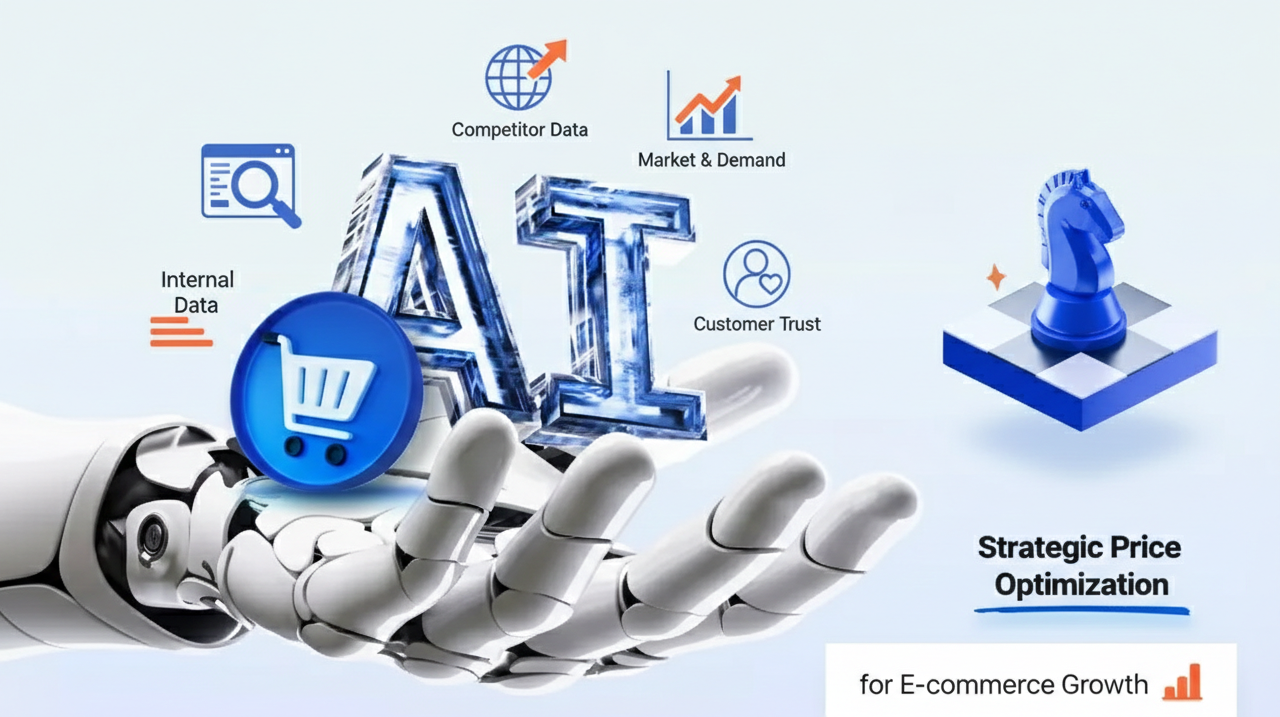
An AI model is only as good as its data. Your AI dynamic pricing strategy requires a robust foundation built on four critical data pillars:
- Internal Data: Your historical sales, inventory levels, product costs, and profit margins.
- Competitor Data: Real-time pricing, stock status, and promotional activity from key rivals.
- Market & Demand Data: Search trends, seasonality, broader economic indicators, and event calendars.
- Customer Data: Segmentation, purchase history, price elasticity, and browsing behavior.
Neglecting any single pillar creates blind spots that lead to poor pricing decisions. This is where expertise in AI & automation and data integration becomes critical.
A Step-by-Step Guide to Implementing AI Dynamic Pricing
A successful rollout requires meticulous planning. Follow this phased approach to build a system that scales with confidence.
Phase 1: Strategy & Goal Definition
Before touching technology, define your "why." What is your primary objective? Is it margin expansion, market share growth, or inventory liquidation? Set clear, measurable goals for your AI pricing model. Also, decide which product categories are best suited to start (e.g., high-turnover, competitive markets).
Phase 2: Data Infrastructure Audit
You must consolidate and clean the data from the four pillars. This often involves integrating your Shopify development store with competitor tracking tools, inventory management systems, and analytics platforms. A clean, unified data pipeline is non-negotiable for accurate AI predictions.
Phase 3: Algorithm Selection & Rule Setting
Will you use rule-based repricing, machine learning models, or a hybrid? More importantly, you must establish ethical guardrails and business rules. These rules constrain the AI to operate within your brand's comfort zone, a topic we'll delve into next.
Phase 4: Controlled Pilot Launch
Never launch site-wide. Start with a limited, non-critical product segment. Run the AI in a "shadow mode" to compare its suggested prices against your manual ones. This low-risk pilot validates the model and builds internal trust before full commitment.
Phase 5: Full Integration & Monitoring
Integrate the AI pricing engine with your live e-commerce platform. This is a technical process best handled by specialists. Once live, continuous monitoring against your KPIs is essential. The system is now operational, but your work shifts to governance and optimization. Implementing this requires a blend of strategic vision and technical precision. Partner with The Night Marketer to architect an AI-powered pricing system that maximizes revenue while fortifying customer loyalty. Our AI & Automation and Shopify Development teams turn this blueprint into reality.
Ethical Guardrails: Designing Rules to Protect Your Brand
Guardrails are the parameters you set to ensure your AI acts in your brand's long-term interest. They are the safety features on your profit engine. Without them, an AI can optimize for a single metric (like daily revenue) in a way that harms customer lifetime value. Key guardrails to implement include: * Price Floor/Ceiling: Absolute minimum and maximum prices for any item. * Maximum Change Frequency: Limits on how often a price can change (e.g., not more than once per day). * Maximum Change Percentage: Caps on the size of a single price increase or decrease. * Brand Alignment Rules: Rules that prevent pricing that contradicts brand messaging (e.g., no surge pricing on essential items).
Measuring Success: The 5 KPIs for Your AI Pricing Model
Move beyond vanity metrics. Track these five key performance indicators to gauge the true impact of your AI dynamic pricing strategy.
| KPI | What It Measures | Why It Matters |
|---|---|---|
| Gross Margin Uplift | The change in average profit margin per item sold. | The core financial indicator of pricing effectiveness. |
| Revenue Impact | Total sales revenue attributed to pricing changes. | Shows top-line growth while considering margin. |
| Competitive Price Index | How your prices are positioned against key competitors. | Ensures you're not blindly under- or over-pricing the market. |
| Inventory Turnover Rate | How quickly stock sells through. | Critical for assessing pricing efficiency on slow/fast-moving goods. |
| Customer Price Perception | Metrics like repeat purchase rate and customer satisfaction (CSAT). | Guards against trust erosion and measures long-term health. |
Common Pitfalls to Avoid When Launching AI Pricing
- Setting and Forgetting: AI requires ongoing oversight and rule refinement.
- Chasing Competitors into Losses: Don't let a race to the bottom be your default rule.
- Ignoring Customer Segmentation: Not all customers are equally price-sensitive.
- Starting Too Big: A failed site-wide launch is catastrophic. Pilot first.
- Neglecting Communication: Be transparent if prices change frequently; manage expectations through your digital marketing channels.
FAQ: Your AI Dynamic Pricing Questions, Answered
Will AI dynamic pricing make my prices constantly change, confusing customers? Not necessarily. Effective strategies use guardrails to limit change frequency. Prices can be updated overnight or weekly, not minute-by-minute. Transparency in marketing can also manage customer expectations.
Is AI pricing only for large enterprises like Amazon? No. With modern SaaS tools and agency expertise, mid-market e-commerce brands can effectively implement scaled-down, strategic AI pricing. The technology is now accessible and cost-effective.
How do I prevent starting a price war with competitors? Your AI should be governed by rules that include minimum profit margins. It should react strategically, not reflexively. The goal is intelligent pricing, not simply being the cheapest.
What's the typical ROI timeline for implementing an AI pricing system? A well-executed pilot can show measurable margin improvements within 4-8 weeks. Full-scale rollout typically justifies the investment within the first fiscal quarter, depending on product volume and margin structure.
Can AI dynamic pricing work for a luxury or brand-focused retailer? Absolutely. For luxury brands, the guardrails are stricter, often prioritizing price consistency and brand equity over frequent changes. The AI can focus on optimizing within a very narrow, premium price band.
Do I need a data scientist on staff to run this? Not if you partner with a specialized agency. A competent partner will provide the data science, technology, and strategic oversight as a service, allowing you to focus on your business.
How does AI pricing integrate with my existing promotions and discounts? The best systems treat promotional calendars as a key data input. The AI can adjust base prices around planned promotions or even suggest optimal discount depths to meet inventory goals without eroding brand value.
What are the first steps I should take to explore this for my brand? Conduct an internal audit of your data readiness and pricing pain points. Then, seek a consultation with an agency that can translate those needs into a concrete strategy and technical plan.
Conclusion: The Strategic Imperative of Intelligent Pricing
Static pricing is a relic in a dynamic world. The future belongs to brands that leverage data not just to understand their customer but to communicate value intelligently through price. A sophisticated AI dynamic pricing strategy is no longer a competitive advantage; it is becoming a table-stakes requirement for sustainable growth. It represents the ultimate fusion of data science and commercial strategy. The journey requires careful planning, ethical foresight, and expert execution. But the reward is a pricing engine that works tirelessly to boost profitability while safeguarding the customer relationships that ensure your brand’s future. Partner with The Night Marketer to architect an AI-powered pricing system that maximizes revenue while fortifying customer loyalty. Let our integrated expertise in AI & automation, Shopify Development, and Digital Marketing guide your brand into the new era of intelligent commerce