
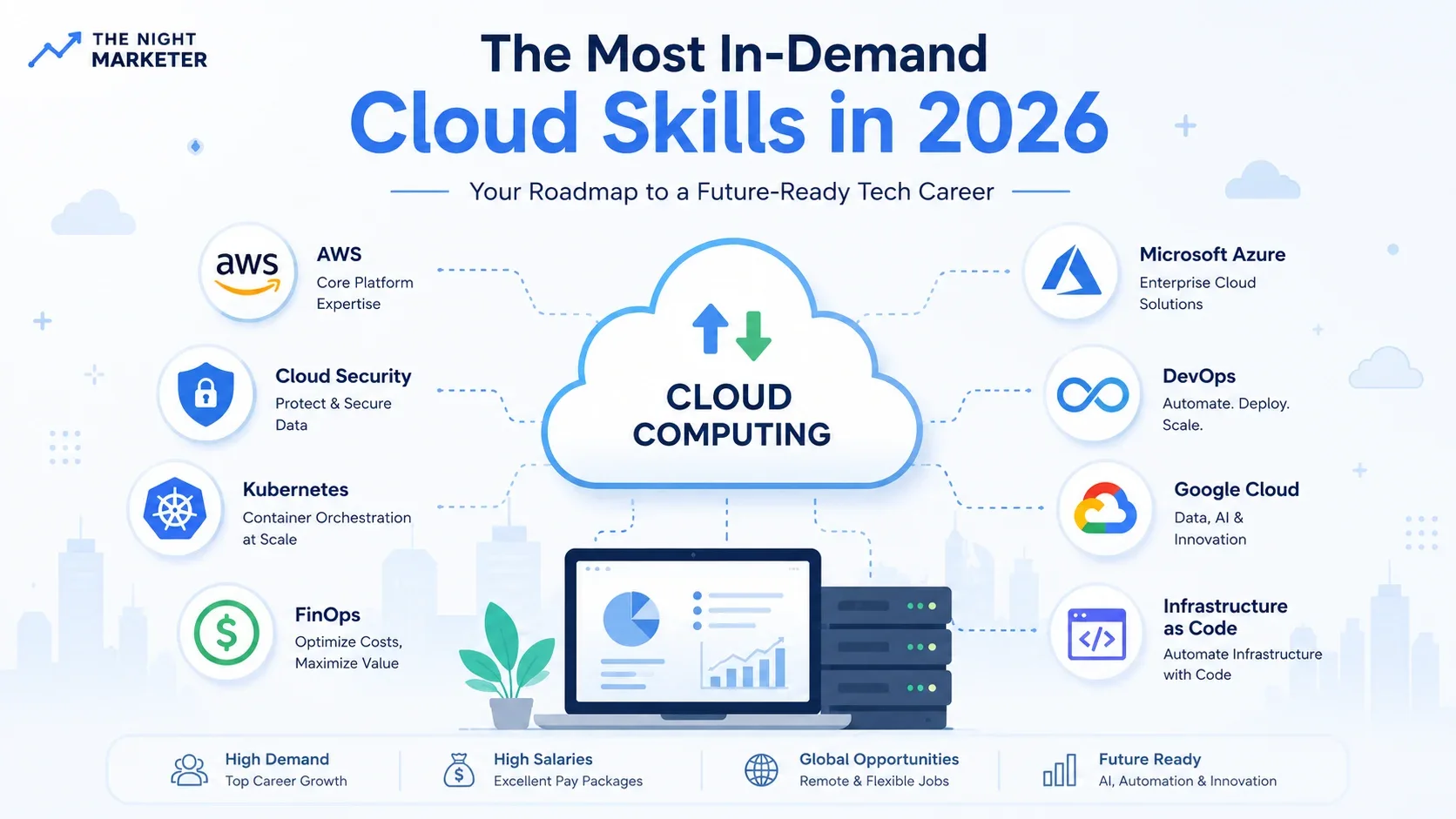
In short
- Cloud computing remains one of the fastest-growing technology careers in 2026.
- AWS, Azure, DevOps, Cloud Security, Kubernetes, and FinOps are among the highest-paying cloud skills.
- Building real-world projects alongside certifications significantly improves your chances of landing a cloud job.
You applied for a "remote-friendly, six-figure" tech role last week. So did 400 other people. Most got auto-rejected. A handful got interviews. And the person who got the offer? They weren't the smartest in the pile - they just had the exact cloud skill the company was desperate for.
Here's the number that should stop you in your tracks: by 2026, more than 90% of organizations are expected to face IT skills shortages, and that gap is projected to cost businesses an estimated $5.5 trillion. Meanwhile, the global cloud market - worth roughly $912 billion in 2025 - is on track to grow past $5.9 trillion by 2035.
Translation: companies have more cloud work than people to do it, and they're paying a premium to fix that.
So the question isn't should you learn cloud skills. It's which ones actually move the needle in 2026.This guide breaks down the exact skills employers are fighting over, what they pay, the tools you'll use, the mistakes that quietly kill careers, and a step-by-step roadmap you can start this week - even if you're beginning from zero.
What Are "Cloud Skills," Really?
Cloud computing means renting computing power - servers, storage, databases, networking - over the internet instead of buying and babysitting your own machines. Think of it like electricity. You don't build a power plant in your backyard; you plug into the grid and pay for what you use. The cloud is that grid, but for computers.Cloud skills are simply the abilities that let you build, run, secure, and optimize things on that grid - usually on one of the "big three" platforms: Amazon Web Services (AWS), Microsoft Azure, or Google Cloud Platform (GCP).
That covers a wide range: launching apps that scale automatically, keeping data safe, cutting waste from monthly bills, and connecting AI systems to reliable infrastructure. You don't need all of it. You need the right slice - and that's what we're mapping out.
Why Cloud Skills Matter So Much in 2026
A few years ago, "moving to the cloud" was the big project. That migration is mostly done. Now the game has shifted to optimizing what's already there - and that's where the money and demand have moved.
Here's why it's a smart bet right now:
Ridiculous demand. The US alone sees roughly 317,700 cloud-related job openings a year, and cloud roles are projected to grow 25–26% through 2034 - far faster than the average job.
The pay is real. The average cloud engineer earns around $130,000 in the US. Entry-level roles start near $80,000–$110,000, and senior specialists clear $175,000+.
AI runs on the cloud. Every company racing to add AI needs someone who can connect those models to secure, scalable infrastructure. AI systems can't function without solid cloud foundations - which is pushing cloud salaries even higher.
It travels. Most cloud work is remote or hybrid. An engineer in a smaller city can work for a US company and earn close to US rates - one of the biggest shifts in hiring this decade.
Expert take: The single most valuable trait in cloud isn't raw intelligence - it's adaptability. Tools change fast. The pros who thrive treat learning as a permanent part of the job, not a phase.
How These Skills Actually Work—The 6 That Matter Most
Let's get specific. Below are the skills employers are actually posting for in 2026 - what each one is, why it pays, and a pro tip most beginners miss.
1. Core Platform Expertise (AWS, Azure, or GCP)
What it is: Deep, hands-on command of at least one major platform - compute, storage, identity, and networking.
Why it pays: AWS holds about 31% market share with the most job listings, Azure dominates enterprise and Microsoft-heavy companies, and GCP pays a premium for AI and data roles because fewer people are certified.
Pro tip: Start with one platform, not three. AWS gives beginners the fastest path to a first job simply because there are more openings.
2. Cloud Security
What it is: Protecting cloud systems through identity and access management (IAM), encryption, and compliance with rules like GDPR and HIPAA.
Why it pays: As more companies move online, cybercriminals follow. Azure security specialists average around $162,000, and security expertise is now expected in nearly every cloud role - not just security jobs.
Pro tip: Learn IAM cold. Most real-world breaches come down to someone having access they never should have had.
3. DevOps & Infrastructure as Code (IaC)
What it is: Automating how software gets built, tested, and deployed—using tools like Terraform to manage infrastructure through code and CI/CD pipelines to ship updates fast.
Why it pays: Automation sits at the heart of modern operations. AWS DevOps engineers average around $155,000 because they make everything else faster and more reliable.
Pro tip: If you can write code that spins up an entire environment in minutes instead of weeks, you become the person teams can't function without.
4. Containers & Kubernetes
What it is: Packaging apps with Docker so they run anywhere, then managing them at scale with Kubernetes.
Why it pays: Containers are the backbone of scalable, cloud-native apps. Kubernetes has a reputation for being hard - which is exactly why the people who master it get paid.
Pro tip: Don't just learn commands. Understand why orchestration exists - the "why" is what interviewers probe.
5. Cloud FinOps (Cost Optimization)
What it is: Managing and cutting cloud spend without breaking anything. One of the hottest emerging roles of 2026.
Why it pays: Companies are done asking if they should be in the cloud - now they want to know why the bill is so high. Someone who saves a company six figures a year pays for their own salary many times over.
Pro tip: This is a fantastic entry point for people from finance or analytics backgrounds. It rewards business sense as much as technical depth.
6. Multi-Cloud & AI Integration
What it is: Working across more than one platform and connecting AI workloads (vector databases, RAG pipelines, model deployment) to cloud infrastructure.
Why it pays: Multi-cloud architects report averages of $195,000–$210,000, and professionals certified in two platforms earn roughly 18–25% more than single-platform peers.
Pro tip: Get genuinely strong in one cloud first. Add a second platform 1–2 years in - that's where salary growth really compounds.
Your Step-by-Step Beginner Roadmap
You don't need a computer science degree. You need a plan and proof you can do the work. Here's a realistic path.
Step 1 - Learn the fundamentals (Weeks 1–4). Get comfortable with the basics of how the internet, servers, and networking work - IP addresses, DNS, and how data moves. Why it matters: Skipping this is the #1 reason beginners feel lost later. Mistake to avoid: Don't jump straight to advanced tools before you understand the ground they stand on.
Step 2 - Pick one platform and go deep (Months 2–3). Choose AWS if you want the most job options, Azure if you're aiming at enterprise, GCP if you love data and AI. Mistake to avoid: Platform-hopping. Depth beats a shallow tour of all three.
Step 3 - Earn a foundational certification (Month 3–4). Start with an entry-level cert like the AWS Certified Cloud Practitioner or Azure Fundamentals (AZ-900). Certified professionals earn measurably more - AWS certifications alone are linked to a ~26% salary bump. Why it matters: A cert removes the guesswork for recruiters and gets your resume past the first filter.
Step 4 - Build real, visible projects (ongoing). Deploy a live web app. Automate something with Terraform. Break it, fix it, document it on GitHub. Why it matters: Employers hire proof, not promises. A single strong project beats a wall of certificates.
Step 5 - Add security and automation, then apply (Month 5+). Layer in IAM basics and a CI/CD pipeline, then start applying - even before you feel "ready." Mistake to avoid: Waiting to master everything. Apply as you learn; the interviews teach you what to study next.
Common Mistakes to Avoid
Collecting certs, skipping projects. Certificates open doors; projects prove you can walk through them. Fix: build something real for every concept you learn.
Trying to learn all three clouds at once. It feels productive but leaves you shallow everywhere. Fix: master one, then expand.
Ignoring security until later. It's now expected in nearly every role. Fix: weave IAM and encryption basics into your learning from day one.
Waiting to feel "ready." No one ever does. Fix: apply while you're still learning - interviews are free training.
Memorizing without understanding. Tools change; concepts don't. Fix: always ask why a tool exists, not just how to use it.
Best Tools to Learn (Free & Paid)
Future Trends: Where Cloud Is Heading
AI and cloud are merging into one career. The highest-paying roles now blend cloud architecture with AI deployment. Learning both puts you at the center of the fastest-growing area in tech.
Automation is reshaping the day-to-day. Some routine tasks are being automated away - but overall complexity is rising, so skilled humans are more needed, not less. The trick is to own the complex, judgment-heavy work machines can't.
Multi-cloud is the new normal. A typical large company might run its product on AWS, business apps on Azure, and AI on GCP. Engineers who move between platforms without a second hire are exactly what enterprises want.
FinOps and security keep climbing. As spending grows and regulations tighten, the people who control costs and protect data will only get more valuable.
Conclusion
The cloud isn't a "someday" skill anymore—it's the infrastructure the entire digital economy runs on, and there aren't enough people who understand it. That shortage is your opening.
Here's what to remember:
Demand is enormous, salaries are strong, and AI is pushing both higher.
Depth beats breadth—master one platform before adding a second.
Certifications get you noticed; real projects get you hired.
Security, DevOps, FinOps, and AI integration are where the premiums live.
You don't need a degree. You need a roadmap and the discipline to build.
Pick one skill from this guide, start a project this week, and apply before you feel ready. That's the entire difference between reading about opportunity and taking it.