In short
- ✓ Custom ERP systems eliminate production planning errors by replacing manual spreadsheets with real-time, centralized data.
- ✓ Integrated inventory, procurement, and production workflows improve visibility, reduce delays, and streamline manufacturing operations.
- ✓ Real-time analytics and AI-powered forecasting help manufacturers optimize scheduling, minimize waste, and increase operational efficiency.
- ✓ Scalable ERP solutions support business growth by automating processes, improving collaboration, and enabling smarter production planning.
Production planning is one of the most critical functions in manufacturing, yet it is also one of the most error-prone when managed through spreadsheets. Many manufacturing companies still rely on Excel or similar tools to schedule production, track resources, and coordinate supply chains. While this may work at a small scale, it quickly becomes unreliable as operations grow in complexity.
This is where a custom ERP system for manufacturing becomes essential. Unlike generic tools, ERP systems integrate production planning, inventory management, procurement, and operations into a single centralized platform. This eliminates the fragmentation that leads to costly planning errors.
The Hidden Cost of Spreadsheet-Based Production Planning
Manufacturing teams that depend on manual spreadsheets face a consistent set of challenges. Each error compounds, creating delays and inefficiencies that ripple throughout the supply chain.
Inaccurate Production Scheduling
One of the most common issues manufacturers face is inaccurate production scheduling. When teams manually update spreadsheets, even a small error can cascade into delays, overproduction, or stock shortages. A custom ERP solution solves this by providing:
Real-time production data that updates across all departments
Automated scheduling that accounts for dependencies
Dependency tracking across production lines and teams
This ensures that production plans are always based on the latest available information, eliminating the lag time that causes errors in spreadsheet-based systems.
Poor Inventory Visibility
Another major challenge is poor inventory visibility. Production planning depends heavily on raw material availability, but spreadsheets often fail to reflect real-time stock levels. This leads to either:
Production stoppages due to unexpected material shortages
Excess inventory buildup from over-ordering
Inefficient working capital tied up in surplus stock
With an ERP system, inventory data is updated instantly as materials are used or received. This enables manufacturers to plan production cycles accurately and avoid disruptions.
Department Silos and Coordination Failures
In traditional setups, procurement, warehouse, and production teams often work in silos. This misalignment causes:
Delays in material procurement
Incorrect demand forecasting
Inefficient resource allocation
Miscommunication between departments
A manufacturing ERP system solves this by unifying these departments under a single workflow, ensuring that everyone operates with the same data and timelines.
How Custom ERP Systems Solve These Problems
Beyond eliminating errors, a custom ERP system transforms how manufacturing operations function at a fundamental level.
Real-Time Visibility and Centralized Data
Unlike spreadsheets where information becomes outdated moments after being entered, ERP systems provide real-time visibility across your entire operation. Every team member accesses the same current data, reducing miscommunication and enabling faster decision-making.
Reduced Human Dependency and Standardized Processes
Another key advantage of a custom ERP system is reduced human dependency. In spreadsheet-based environments, production planning heavily relies on individual expertise, which increases the risk of inconsistency and errors. ERP systems standardize processes, ensuring that production logic remains consistent even when teams change or scale.
Scalability Without Disruption
For growing manufacturers, scalability is another major concern. Spreadsheet-based systems become increasingly difficult to manage as product lines expand or new factories are added. A custom ERP for manufacturing businesses is designed to scale with operations, allowing companies to:
Add new production lines seamlessly
Expand to multiple warehouses
Integrate new suppliers into workflows
Manage increased product SKUs
All without disrupting existing workflows or data integrity.
Advanced Reporting and Real-Time Analytics
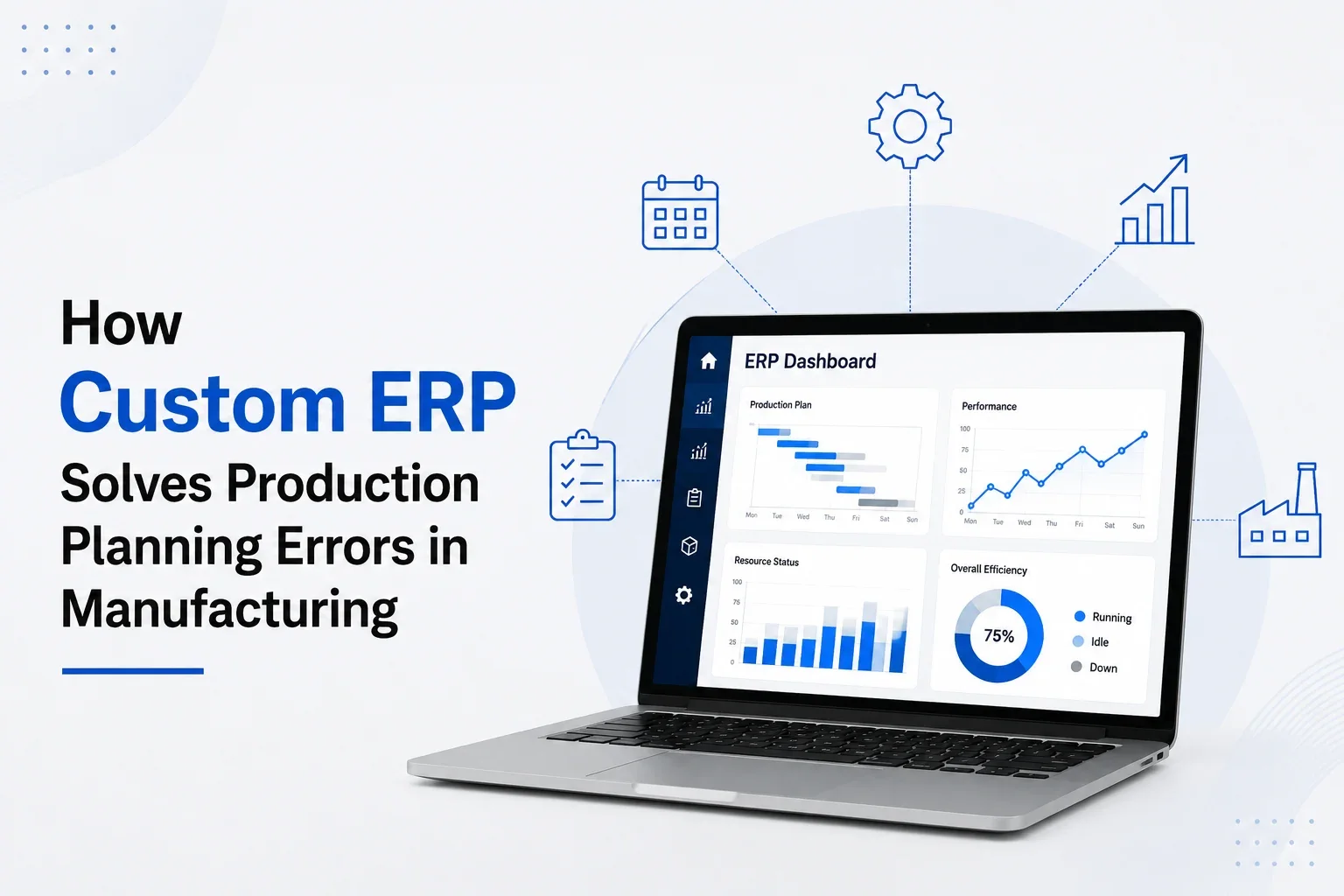
Additionally, ERP systems provide advanced reporting and analytics, which are nearly impossible to maintain accurately in spreadsheets. Managers can access real-time dashboards that show:
Production efficiency metrics
Machine utilization rates
Order progress and fulfillment status
Bottleneck identification
These insights help decision-makers identify bottlenecks and optimize production planning continuously.
Improved Demand Forecasting
ERP systems help manufacturers achieve better demand forecasting accuracy. By integrating sales, inventory, and production data, businesses can:
Predict demand more effectively
Adjust production schedules accordingly
Reduce waste and overproduction
Improve overall profitability
AI-Powered ERP: The Next Evolution
Modern custom ERP systems can also integrate AI-powered optimization features to further improve production planning accuracy and operational efficiency.
AI capabilities can help manufacturers:
Predict demand fluctuations based on historical data and market trends
Recommend optimized production schedules that minimize idle time and bottlenecks
Identify bottlenecks before they occur, enabling proactive problem-solving
Improve raw material planning and procurement timing
Reduce lead times through intelligent resource allocation
This transforms ERP from a static planning system into an intelligent decision-support system that continuously improves operational efficiency and adapts to changing market conditions.
Why Move Beyond Spreadsheets Now?
In today's competitive manufacturing environment, relying on spreadsheets for production planning is no longer sustainable. The cost of errors whether in delays, inventory mismatches, or inefficient scheduling directly impacts customer satisfaction and revenue.
Every day without proper planning visibility compounds:
Lost production hours
Customer delivery delays
Excess inventory carrying costs
Supply chain disruptions
A custom ERP system does not just replace spreadsheets; it transforms how manufacturing operations are managed. From real-time visibility to automated planning and cross-department coordination, ERP systems provide the structure needed for scalable and efficient production planning.
Ready to Eliminate Production Planning Errors?
For manufacturing businesses experiencing frequent planning errors, delays, or coordination issues, adopting a custom ERP system is not just an upgrade, it is a necessity for long-term growth.
At The Night Marketer, we build custom ERP and CRM solutions tailored for manufacturing businesses that want to move beyond outdated spreadsheet systems. Our ERP solutions are designed to:
✓ Eliminate production inefficiencies
✓ Improve visibility across all departments
✓ Automate critical workflows
✓ Scale with your growing operations
Explore more about our ERP development services and see how we can transform your manufacturing operations: