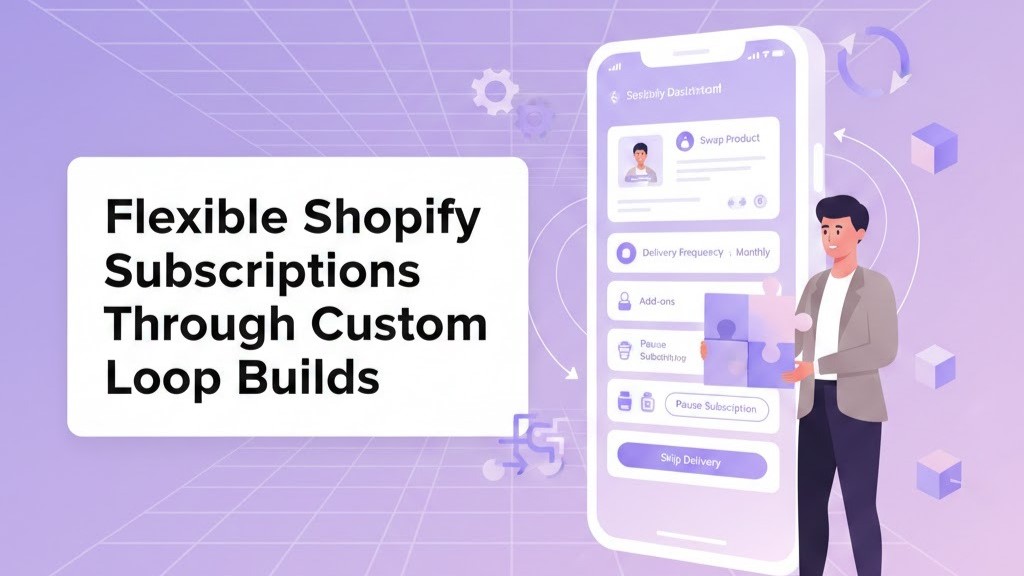
A subscription bundle lets customers buy a group of products on a recurring schedule. A build-your-own bundle adds product choice within rules set by the merchant. For a Shopify brand, the opportunity is not just a larger first basket: customers should understand the bundle, receive products they want and be able to manage future orders without unnecessary support.
When does a bundle solve a real customer problem?
Look for products customers naturally use together, a replenishment cycle that makes sense and a clear reason to choose more than one item. Bundling unrelated products solely to increase basket value can produce excess stock, dissatisfaction or early cancellation. Interview support staff and review actual order combinations before defining the assortment.
Loop's Build your bundle guide describes fixed-size and range-based bundles, product selection and post-purchase editing. Its prerequisites include selling-plan/product setup and the relevant theme snippet. Confirm these requirements in the target store before estimating development effort.
Decide the assortment, rules and economics
| Scope decision | What to specify | QA example |
|---|---|---|
| Eligible products | Variants, availability and exclusions | An unavailable variant cannot be selected |
| Bundle size | Required quantity or permitted range | A customer cannot proceed with an invalid quantity |
| Purchase options | Recurring and any one-time options | The order clearly displays the selected option |
| Pricing | Applicable discounts and margin floor | The checkout total matches the advertised promise |
| Editing | Allowed post-purchase changes | A future bundle update preserves valid contents |
| Operations | Picking, stock and support ownership | Fulfilment receives the intended items |
Why discount combinations need special attention
Loop documents that bundle discounts can apply in addition to selling-plan discounts. Do not infer the final payable amount by reading only the headline percentage on the storefront. Test the actual combination in the cart and checkout, including any other eligible promotion. See the bundle FAQs.
Approve the offer using contribution, not AOV alone. A higher basket value can still be less profitable when the bundle adds expensive items, packing effort or shipping subsidy. Model the smallest and largest allowed bundle, and examine low-margin product combinations rather than checking only the most attractive sample.
Implementation checklist from theme to renewal
- Map the intended journey. Decide how customers discover the bundle, select products, see progress, choose the purchase option and reach checkout. Keep the current selection visible on mobile without covering important controls.
- Configure the selling-plan foundation. Verify eligible products, variants and schedule. Document which settings belong to Shopify and which are configured in Loop, so future changes have a clear owner.
- Install and verify the integration. Follow the bundle overview and snippet instructions. Check whether the current theme already contains an integration before adding another. Theme updates should include regression tests for cart grouping and bundle editing.
- Test the full order path. Exercise minimum and maximum quantities, sold-out variants, repeated clicks, cart editing, discount combinations, mobile checkout and customer-portal changes. A visually complete bundle selector is not evidence of a correct recurring order.
- Prepare the support and fulfilment handoff. Provide examples of how bundle contents appear downstream, how permitted substitutions are handled and who resolves a mismatch. Do not launch a promotion that operations cannot deliver.
What should you measure after launch?
Track bundle-start to purchase completion, order value, contribution, selection errors, support contacts and later renewal behavior. Separate customers who chose a bundle from the full subscriber population. Use comparable observation windows before claiming a retention improvement; bundle customers may already be more engaged than other customers.
If testing a new assortment or presentation, record the hypothesis and what remains unchanged. A launch that simultaneously changes products, pricing, acquisition channels and delivery policy makes attribution difficult. Review cancellations for excess stock or poor product fit rather than treating initial AOV as the final result.
What The Night Marketer can do
We can help scope bundle UX, Shopify theme integration, product-selection rules, analytics and launch QA. The starting deliverable is a tested journey and clear pricing logic, not a guaranteed AOV uplift. Explore our Shopify development work and connect bundle planning to the wider retention strategy.
Frequently asked questions
It lets the customer choose products within merchant-defined bundle rules and purchase them on a recurring schedule.
Loop documents that bundle discounts can apply in addition to selling-plan discounts. Verify the actual cart and checkout total for the permitted combinations.
No. Evaluate contribution, customer fit and later renewals over comparable periods before attributing a retention benefit.